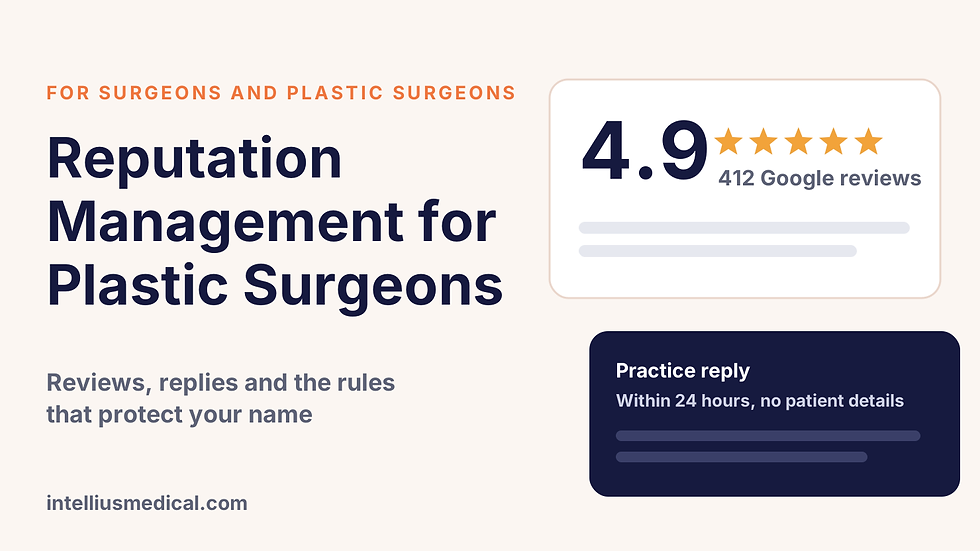
How Surgeons Get More Positive Reviews: 10 Ways for Plastic and Orthopedic Practices

Updated: 3 days ago
Surgeons now compete online as much as they do in referral networks. Plastic surgeons, orthopedic surgeons and spine surgeons all need a steady flow of positive reviews so patients choose them over the practice down the road.
Why Patient Reviews Matter for Surgeons
Nowadays, people rely on online reviews just like individual recommendations, so if you can manage to have lots of positive reviews by your patients, then many people will be motivated to select your surgical practice over others.
Remember, the best advertising, as well as marketing campaign, is also not able to replace the worth of a decent referral from an existing or previous patient.
A large number of positive feedbacks of your patients can play a pivotal role in generating positive impression and acquiring a great success along with financial sustainability.
Patients who move to a new city, or who need a surgeon for the first time, have no one to ask. Online reviews become their recommendation.
Positive reviews for surgeons also feed your Google Business Profile, which affects where your practice shows on Google Maps. Our guide to local SEO for plastic surgeons covers that side.
Many happy patients never post a review unless someone asks. Asking every patient, the right way, is how surgeons get more patient reviews.
Where patient reviews for surgeons matter | ||
Platform | Who reads it | What to do |
Google Business Profile | Local patients searching Maps | Ask every patient here first |
Healthgrades | Patients comparing surgeons | Claim and complete your profile |
RealSelf | Cosmetic surgery patients | Plastic surgeons: answer questions there |
Vitals and WebMD | Insurance-based patients | Key for ortho and spine |
Yelp | Some cosmetic patients | Don't ask for Yelp reviews; its rules discourage it |
10 Ways Surgeons Get More Positive Reviews
The first thing that you should remember is that the care at your practice is high-quality and the behavior of staff should be polite and kind. If people have experienced harsh and rude behavior with inferior quality of treatment, then they will more likely to post their experience on popular review websites.
Now, let's discuss ten ways through which you can expect to earn better reviews from surgical patients:

1. Complete Every Surgeon Profile
To generate lots of reviews, you need to create each and every review profile with utmost finesse. You need to update the profile from time-to-time so that people can know about the updated services of your practice.
You need to attach professional credentials accompanied by the facilities to assist them to realize that your practice is the right place for their procedure.
Don’t forget to include the names of accepted insurance providers. These pieces of information are very crucial to attract more patients to your practice website and thereby your practice. They also help to generate additional reviews on those particular websites that had introduced your practice to viewers.
Start with your Google Business Profile: list every surgeon, procedure and insurance plan. Our guide to local SEO for doctors and surgeons walks through the setup.
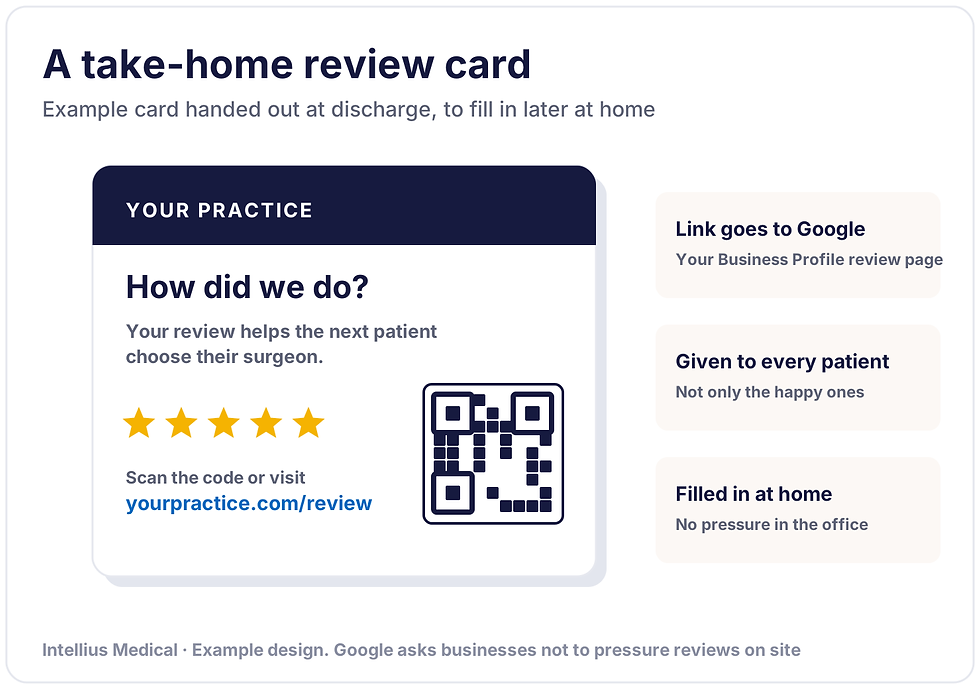
2. Hand Patients a Take-Home Review Card
You should provide inspiration to your patients to post reviews about the services of your practice. You should provide them with review reminders through the tools of offline marketing. Always try to bring reviews to well-known review websites.
Quote respective patient reviews or attach your score, certificates or awards that you have gained for the excellence of your services by the particular review websites.
Google lets you create a review link or QR code from your Business Profile (Google's guide). Print it on a card patients take home.
Ways to ask surgical patients for a review | ||
Channel | Best moment | Note |
Take-home card | At discharge | No pressure in the office |
Text message | The day after a follow-up visit | Short link to Google |
After the post-op visit | One button, no incentive | |
Surgeon ask | When the patient sees the result | Same ask for every patient |
3. Give Care Patients Want to Write About
Poor services often result in negative reviews and too many negative reviews can worsen the reputation of your practice.
Most patients write glowing reviews about their surgeon or the specific medical facility while they have received the top-class personal care. An interesting fact is that assessments posted on topmost online review websites like Yelp, Vitals, or Healthgrades rarely have specifications on diagnostic capability, medical expertise or on associated tools and technologies.
Rather, most of the reviews (both positive and negative) are based on the emotional aspects regarding the particular medical care like bedside manner, responsiveness etc. That means the topmost priority needs to be your patients. You should always show enthusiasm while communicating with them.
4. Reply to Every Review
It’s essential to check online reviews whenever you get time or on weekends. If you come across good and positive reviews, then convey your gratitude to those patients. In case of negative reviews, apologize first and then communicate with those patients about their experiences.
If anyone doesn't want to continue talking in the public forum, then you can resume the communication via emails or phone calls. After sorting out the issue, invite them to update their review if they wish.
Reply without confirming that anyone is your patient. Our guide to reputation management for plastic surgeons covers the HIPAA rules for replies.
5. Ask in Your Follow-Up Emails and Calls
If you make follow-up calls or send follow-up emails to know about the present status of the health of your patients or about the services (whatever they have received), then they will be automatically inspired to write positive reviews about your services.
If you keep on communicating with your existing and previous patients, then they will get positive impressions about your services and thus you can expect to get more good reviews.

Build the ask into the same messages you already send, like post-op appointment reminders. It is one of the easiest patient retention habits too.
6. Fix What Reviews Point Out
After going through reviews of your practice, if you think some services of your practice should be modified, then start work on it accordingly.
After completion of the work, write a detailed post about the updated services and post it online so that your patients can realize that you value their opinions, reviews, and comments. It motivates them to write positive reviews about your services.
7. Ask Real Patients Only, and Ask All of Them
Fake reviews are now illegal, not just risky. The FTC's 2024 rule on fake reviews bans fake reviews, buying positive ones and suppressing negative ones.
Google's rules go further: no incentives, no asking only happy patients, and no reviews from staff (Google's review policy). For the HIPAA and FTC fines practices have paid, see our plastic surgeon reputation guide.
Always focus on your patients and the service quality of your practice. These are sufficient to inspire patients to write reviews on your practice.

Where surgeons can ask for reviews | ||
Platform | Can you ask? | What to know |
Yes, every patient | No incentives and no pressure in the office | |
Yelp | No | |
Healthgrades and Vitals | Yes | Send patients to your claimed profile |
Your website | Yes, with written consent | Use reviews as testimonials |
8. Use Surveys for Website Testimonials
Patients, who have already availed medical facilities from your practice, are mostly interested to share their experience. You can make their work easy by sending them an invitation to an online survey.
After the completion of the survey, request them to give you permission to post their reviews on your practice website.
Send the Google review link to every patient, not only those who score you highly in the survey.
9. Handle Negative Reviews Calmly
The negative review management is equally important as generating new reviews. If any patient has any complaint regarding the services of your practice and posts negative reviews, then you need to handle those criticisms very carefully. It's not a good idea to run away from negative reviews.
This attitude will inspire other people to think that you are very much committed to your work.
10. Give Patients Easy Ways to Give Feedback
You can provide special cards to patients and request them to write reviews on their experience and later post it to your practice website (after having their permission).
Management of reputation of your practice can tremendously increase the number of patient reviews. Don't waste time and find out the appropriate tools that are able to centralize the review management task. Thus, you can easily find out the requirements of your patients.
Patient Reviews for Surgeons: FAQs
Can a surgeon ask every patient for a review?
Yes. Google allows it as long as you ask everyone, offer nothing in return and don't pressure patients in the office.
Can surgeons reply to patient reviews?
Yes, but never confirm the reviewer is your patient or mention their care. Our surgeon reputation management guide shows safe replies.
Which reviews matter most for orthopedic surgeons?
Google first, because it feeds Google Maps. Then Healthgrades and Vitals, which many insurance-based patients check when comparing surgeons.
Get More Positive Reviews for Your Surgical Practice
Intellius Medical builds review requests into the patient journey for surgeons, alongside patient retention, SEO and Google Business Profile work. See how we grew a Dallas plastic surgery practice and a Manhattan rhinoplasty practice.