AI Search Optimization for Cosmetic & Plastic Surgeons

Updated: 2 days ago
AI Search Optimization: A patient asks ChatGPT for the best facelift surgeon in Dallas, and five names show up. Most surgeons have no idea their name was never mentioned.
58.3%
of ranked keywords now carry an AI Overview
31.7%
is how often the practice is quoted inside it
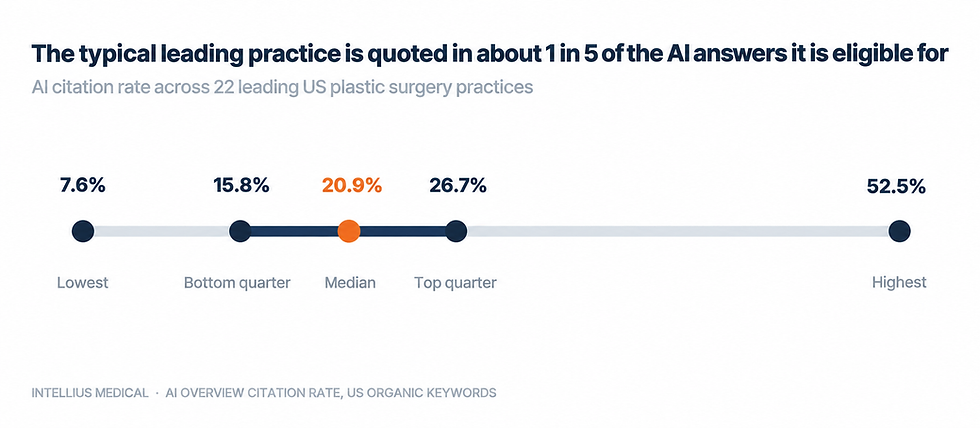
20.9%
median citation rate across 22 practices
2,749
AI citations measured
A patient asks ChatGPT for the best facelift surgeon in Dallas, and five names show up. This happens thousands of times a day across the country, and most surgeons have no idea their name was never mentioned. You have built a reputation, a practice, and a surgical portfolio that took decades to create, yet a patient's first impression of you now comes from an algorithm that does not read your website. It reads what other people say about you.
What AI Search Optimization Is
AI Search Optimization is the process of getting your practice, your name, and your surgical skills to appear in the answers that AI tools like ChatGPT, Gemini, Perplexity, and Claude provide patients. AI SEO is helping these AI bots to cite you when answering patient questions about procedures, recovery, and the right surgeon for them.
While plastic surgery SEO focused on ranking on Google's 10 blue links, AI Search Optimization is about getting a citation in a paragraph that a patient reads, not a click on any link. That single difference revolutionizes how you think about your practice's visibility.

How AI Engines Decide Who to Cite
The most important thing to know is that AI engines don't read your website like a human or Google crawler. Large language models use retrieval-augmented generation, which involves using a curated set of sources to create an answer. The engines search for institutional authority, editorial coverage, and multiple mentions on credible platforms.
In a Q2 2026 study that looked into AI search visibility in aesthetic medicine, it was found that AI search engines tend to prioritize institutions and practice brands that have board certification as well as accredited training programs, and this happens no matter how many followers a personal practitioner has on social media or how many patient reviews they get. The reason behind this is straightforward: AI engines place greater emphasis on sources they can independently verify as being credible.

If you're looking for a facelift, the engine refers to the American Society of Plastic Surgeons, Cleveland Clinic, or a RealSelf profile with before and after photos, over a practitioner's Instagram following, however impressive. An increase in followers doesn't necessarily mean more AI citations.

What Doesn't Work, and Who's Selling It Anyway
There are a lot of logical-sounding SEO tips that don't hold up to the test. The most obvious is schema markup. More than 2,000 prompts and 9,000 AI citations were analyzed in a study of ChatGPT, Google AI Overviews, and Perplexity. It was discovered that although schema markup is seen on many of the websites cited, its real effect is not as significant as many SEO professionals believe.
A subsequent study that analyzed citation data with corrected regression modeling found schema presence produced an odds ratio of 0.678 with a p-value of .296, which is consistent with a true null effect. There is no measurable benefit of generic schema. The practitioner consensus that schema makes AI visible is just not backed up by citation data of the implementations that dominate the web today.


AI Search Optimization: The Quarterly Decay Problem
Contents that appear at the top of Google rankings may subtly be missing from AI-generated responses. Studies indicate that older content (more than six months) tends to lose citations from ChatGPT, Claude, Gemini, and Perplexity. It takes only thirteen weeks for content to start to lose some of its AI citations.
Ahrefs found that URLs cited by AI assistants are 25.7% fresher on average than standard organic results. The stale content gets indexed in Google and is completely ignored by the engines that create AI answers.
A brand that releases a flagship research in January gets it cited on all four engines by mid-February, and then forgets about it until the next annual cycle sees its citations drop by April. The piece is still ranking on Google, but has effectively disappeared from AI answers.
The piece is still ranking on Google, but has effectively disappeared from AI answers.
The Four Engines and How They Differ
When it comes to sourcing information, Google AI Overviews (AI Search Optimization), ChatGPT, Perplexity, and Gemini operate with their own individual retrieval databases. URL overlap between these platforms hovers around a mere four percent.
You won't necessarily find the same practices and references in Gemini that you see in ChatGPT. Many of Google's AI surfaces pull directly from Google Business Profile information. If you update your GBP, you can see it surface in Gemini in a matter of days.
In April 2026, Google Maps began utilizing Gemini to prevent false editing and thwart review extortion scams. Google began using the model on both the surface layer and backend integrity layer of its Maps information at the same time.
On June 8, 2026, Google Analytics introduced a Google Business Profile integration allowing the seven core GBP metrics to be pulled into Analytics reporting: interactions, calls, bookings, directions requested, website visits, messages, and menu requests. The foundational quality and completeness of your GBP data become important as more AI layers are stacked upon it.
Getting Into the Roundups AI Engines Read
How Plastic Surgeons Get Included in AI Recommendations
The sources used by the AI engines to generate the answers are from a standard list of publishers, directories and review sites that are easily identifiable. The citation structure of the field of aesthetic medicine is divided into three levels of sources.
The clinical and health publisher layer consists of Healthline, WebMD, Cleveland Clinic, Mayo Clinic, Verywell Health, the AAD, and ASPS. These offer the factual, procedural and safety answers. Practices cited as sources, in addition to these sources, acquire retrieval authority by association.
The next level is the trade and professional press, such as The Dermatology Times, Plastic Surgery Practice and education published by Allergan. These are used to validate AI engines with clinical expertise.
The review and community surfaces layer consists of RealSelf, Google Reviews, Yelp, and, more recently, Reddit. RealSelf, in particular, has become a significant source of answers to inquiries such as "Is this procedure worth it?" and "What should I expect?"

Content Built to Be Quoted
AI engines generate brief answers by summarizing longer content. A 40-word summary that directly answers a patient’s question is more likely to be cited than a 400-word explanation that is part of a paragraph.
Content Strategies for Plastic Surgeons
Google's "query fan-out" breaks each patient prompt into multiple sub-queries, retrieves them individually, and synthesizes a unified response. A person looking for information about rhinoplasty in Phoenix is not conducting one search but multiple searches simultaneously, including the surgeons' credentials, the recovery process, before and after pictures, the cost of the procedure, and what to expect during the consultation.
Content focused on one keyword targets just a small segment of that search. Content developed with depth, structure, and broader topic coverage reaches a lot more of it.


Entity Authority: The Surgeon's Name Matters More Than the Domain
Your name as a surgeon is the one most critical entity in your AEO strategy. AI systems link information by entities (people, places, things). While your website's domain name is significant, your personal name is the anchor that ties your credentials, your publications, your patient reviews, and your editorial features together.
When AI views the entity "Dr. [Your Name]" consistently and positively across various reputable sources, it signals a robust indication of authority. Name is the brand in the era of AI.
Name is the brand in the era of AI.
Reddit, RealSelf, Forums
Where Patients Research Plastic Surgeons
These platforms have both positive and negative aspects. They serve as spaces where actual patients pose questions and engage in discussions, and AI systems frequently gather genuine, user-created content from them. On the other hand, these platforms can also be venues for the spread of false information.
A user's bad experience or a wrong claim can be captured by an AI. You must manage your reputation actively on these forums. This does not involve removing all negative comments but rather making sure that the dominant narrative is correct and represents the quality of your work.

Audit Your Own AI Visibility Today
It's time to get a clear picture of where you actually stand. Run a simple but revealing visibility check on your own:
Run 10 key queries on ChatGPT, Perplexity, Google's AI Overview, and Claude. Use real questions your patients are typing in, like:
"Who is the best [your procedure] surgeon in [your city]?"
"Top cosmetic dermatologist in [your city] for injectables?"
"A cosmetic dentist with expertise in smile design."
Keep track of which surgeons or practices come up. Are these the names you're competing with day to day? Look for patterns among the providers that get cited. Are they showing up in editorial roundups? Do they have mentions in certain publications or websites?
Running this set of 10 questions across four different AI tools will give you an honest, unfiltered look at where you really rank in the AI-driven search world right now.

AI Search Optimization: Proof
We were working with a clinic that felt like they were invisible online. They had a fairly good Google ranking, and their consultation requests had stalled. We launched an AI visibility strategy. A few months later, a new patient phoned and stated, "I didn't search you on Google; I asked ChatGPT where to go for this procedure, and your name was there."
They had discovered the clinic via an AI citation. No click, no ad. No click, no ad impression. Just a direct recommendation from the AI. The clinic had become one of the "five names" the patient had received.

FAQS
What is answer engine optimization?
Answer Engine Optimization involves organizing your content and entity signals in such a way that AI platforms like ChatGPT, Gemini, Perplexity, and Google AI Overviews include your practice by name in the answers they produce. Rather than simply aiming to appear on a search results page, the focus is on being the source that the AI cites and quotes.
How is AEO different from SEO?
With traditional SEO, clicks are obtained from a list of blue links that appear when a page is ranked. AEO, on the other hand, gets citations included in a synthesized answer. The patient then reads the answer and does not click on any link. The practice still ends up being discovered. AEO is concerned with what is said about your practice rather than its ranking position, and it functions on a different kind of retrieval and citation logic from Google's PageRank system.
How do I get cited in ChatGPT?
Your name, the name of the surgeon, the location, and the procedures should be stated consistently in every mention on platforms that ChatGPT can access, such as Google News-indexed editorials, RealSelf, Healthline, WebMD, and the websites of professional associations. It is important to establish entity clarity by making the link between your name and your specialty clear in authoritative third-party sources.
Will the use of schema markup help with searches conducted by AI?
Simply having generic schema markup does not result in an increase that can be measured in AI citations. A regression study that included corrected modelling showed that the presence of schema gave an odds ratio of 0.678 and a p-value of .296. Schema that is rich in attributes and has filled-in pricing, ratings, and specifications might have more influence than Article, Organization, or BreadcrumbList schema, but the main factor determining AI citations is still Google's organic rank position.
How often do AI engines update what they say about my practice?
AI citations are updated on an irregular basis, and citations for content older than six months may be lost if it is not refreshed. The time frame for measurable loss is about 13 weeks. AI visibility needs to be refreshed quarterly, with new statistics, new examples, new quotes, and a new dated version block.
Can I pay to appear in AI answers?
In the case of organic AI answers, there is no direct payment model for citation. Sponsored content can impact editorial coverage, and editorial coverage on sites such as HauteLiving.com that are indexed by Google News can be included in AI answers. The citations are not directly bought from the AI platforms, however. Payment only works if it produces a source worthy of a citation and the AI engine considers it authoritative.
How do I check what ChatGPT says about my practice?
Test the same prompts on ChatGPT, Gemini, Perplexity, and Google AI Overviews as your patients would. Record if your practice is named, the context, and if the citation is correct. Repeat this monthly. Citation landscape shifts every 13 weeks, so it's important that you do a quarterly manual audit to know what you're actually seeing.
Does my Google ranking affect AI visibility?
Certainly. The corrected GEE model showed that Google's organic rank position had an odds ratio of 0.762 for each position when it came to predicting AI citations, the result being statistically significant with a p-value less than .001. Pages ranking in position one were cited 43 per cent of the time, this figure dropping to 5 per cent by position seven. The increase in expected AI citations achieved by moving from position five to position two is greater than that produced by any of the schema interventions identified.
Does Reddit really affect AI citations?
Reddit is included in the training data and retrieval collections for AI systems. Although Google's ranking processes might deal with it in a different way, AI systems refer to online communities when giving answers to patients' questions regarding the worth of a procedure and their expectations. The subreddits r/PlasticSurgery and r/Skincare are part of the citation system that AI systems regard as having the authority of a community, just as they do with RealSelf, Yelp, and Google Reviews.