Spine Surgeon Marketing in Texas: Reaching the Patients Who Travel

Updated: 4 days ago
Deciding on spine surgery is not something anyone does on a whim. Patients suffering from back pain, nerve pressure, herniated discs, or spinal instability will usually invest months in reading about their condition and available treatments before selecting a surgeon in Dallas, Houston, San Antonio or Austin.
One out of every five patients will seek a second opinion. Some patients will take the extra step of traveling to another state to see a specific surgeon. In Texas, many drive in from Waco, Tyler, Lubbock or Midland to see a spine surgeon in Dallas–Fort Worth or Houston.
Spine surgeon marketing in Texas is unique as compared to other medical marketing in that the intent is not only to attract someone looking for back pain care, but to inform and educate the patient about what they can do, guide them in assessing the surgeon's qualifications, and assure them that they can make the leap.
When it comes to marketing for spine surgeons, all of these elements must be included with thoughtful message-mapping, targeting, and strategy to ensure potential patients receive the right messaging, education, and motivation from the very first search.
The pool is large: 39% of US adults had back pain in the past 3 months, according to the CDC.

How Texas Spine Patients Choose a Surgeon
Months of Pain Before the First Search
When a spine patient arrives at a surgeon's website, they must have been suffering from pain for months, have tried conservative treatments, or have visited other healthcare providers. When they start to compare surgeons, they might already have some knowledge about their diagnosis and have questions about the surgery.
What Patients Want to Know About a Spine Surgeon
They would like to know if the surgeon treats their condition, what procedures the surgeon performs, qualifications, experience, and track record. They may also wish to learn about the risks and the available alternatives to surgery, as well as the expected benefits.
Questions spine surgeon marketing must answer | |
What they want to know | Where your site answers it |
Does this surgeon treat my condition? | Condition pages |
What procedures does the surgeon perform? | One page per procedure |
Qualifications, experience, track record | Surgeon bio and credentials |
Risks and alternatives to surgery | Procedure pages, treatment ladder |
Expected benefits | Procedure pages and patient stories |
Local Surgeon or Worth the Drive to Dallas or Houston?
The location of the surgeon may also affect the choice, but it is not always the deciding factor. A patient might choose a local surgeon for a minor surgery, but travel farther, say from Tyler to Dallas, when seeking an expert surgeon for a major surgery procedure.
Example: AdventHealth's Spine Health Institute drew patients from 30 states.

The same thing happens inside Texas. Patients from smaller towns drive to the big metros for spine surgery, so spine surgeon marketing in Dallas or Houston should build pages for them too.

Spine surgeon marketing in Texas: towns patients drive in from | ||
Patients from | Big spine markets nearby | Page that helps them book |
Waco | Dallas–Fort Worth, Austin, Houston | A visit plan that fits one day trip |
Tyler | Dallas–Fort Worth, Houston | Remote imaging review before the first trip |
Lubbock | Dallas–Fort Worth | Second-opinion page, travel and hotel guide |
Midland | Dallas–Fort Worth, San Antonio | Secure records upload, follow-up close to home |
Plano, Katy, Round Rock | Their own metro | A location page for each office |
Metro populations in the figure: U.S. Census Bureau, Vintage 2025 estimates. Dallas–Fort Worth 8,477,157; Houston 7,904,627.
Key takeaway: Spine patients compare surgeons on expertise first. Marketing for spine surgeons has to answer their questions before distance comes up.
The Treatment Ladder: From Conservative Care to Surgery
Spine surgery marketing needs to be tailored to the various phases of a patient's treatment path.
Some patients are seeking information on physical therapy, medication, activity changes, or injections. Some have already done conservative treatment and are looking into minimally invasive, spinal fusion, artificial disc replacement, or other surgical options.

Spine surgery marketing by treatment stage | ||
Stage | The patient is reading about | Page to build |
Conservative care | Physical therapy, medication, activity changes | Condition pages with non-surgical options |
Injections | Injections | Treatment pages, when to see a specialist |
Minimally invasive | Minimally invasive options | Procedure pages |
Major surgery | Spinal fusion, artificial disc replacement | Procedure pages, second-opinion page |
One Condition, Every Option: The Herniated Disc Example
The website of the surgeon should be able to educate patients about available treatment options for every condition. For instance, someone who has been diagnosed with a herniated disc should be able to find information about the condition, common treatments, when it may be necessary to see a specialist, and what surgical options a surgeon may have in certain cases.
Dedicated Pages for Each Spine Procedure
Why One Spine Surgery Page Isn't Enough
There are too many procedures to cover in one spine surgery page. Patients looking into the artificial disc replacement have different questions than those looking into endoscopic spine surgery or minimally invasive spinal fusion.
What Each Spine Procedure Page Should Cover
Each major procedure should have its own detailed page, written in language patients can understand. Artificial disc replacement pages can provide information about the procedure, patient selection, benefits, risks, and what the difference is between fusion and disc replacement. Minimally invasive fusion pages should provide information about the procedure and when it might be indicated. The pages of SI joint treatment can cover the symptoms, evaluation, and treatment of SI joint problems.
Example from Texas: Texas Back Institute's cervical disc page compares disc replacement with fusion.
Spine surgeon marketing: what each procedure page should cover | |
Procedure page | What it covers |
Artificial disc replacement | The procedure, patient selection, benefits, risks, fusion vs. disc replacement |
Minimally invasive fusion | The procedure and when it might be indicated |
SI joint treatment | Symptoms, evaluation and treatment of SI joint problems |
Endoscopic spine surgery | Its own patient questions, separate from fusion |
Tie Every Page to the Surgeon and a Booking Option
These pages should link the procedure to the surgeon who performs the procedure, the practice where the procedure is offered, and a clear appointment option. The aim is not to publish as many pages as possible. It is to provide sufficient attention to each procedure, address patient questions, and provide relevant expertise.

It works. Our Dallas plastic surgeon has dedicated pages for each of ten procedure lines, and about 150 inbound patient calls a month come from organic search, with no ads.
Second-Opinion Pages: Reaching Patients Before They Travel
Patients Already Told They Need Surgery
Some of the most valuable opportunities in spine marketing involve patients who have already received a diagnosis or surgical recommendation.
A patient may have been advised to have spinal fusion but may want to know if there are other alternatives. One might have been treated for months with no relief and may request another specialist to look at the situation.
What the Second-Opinion Page Explains
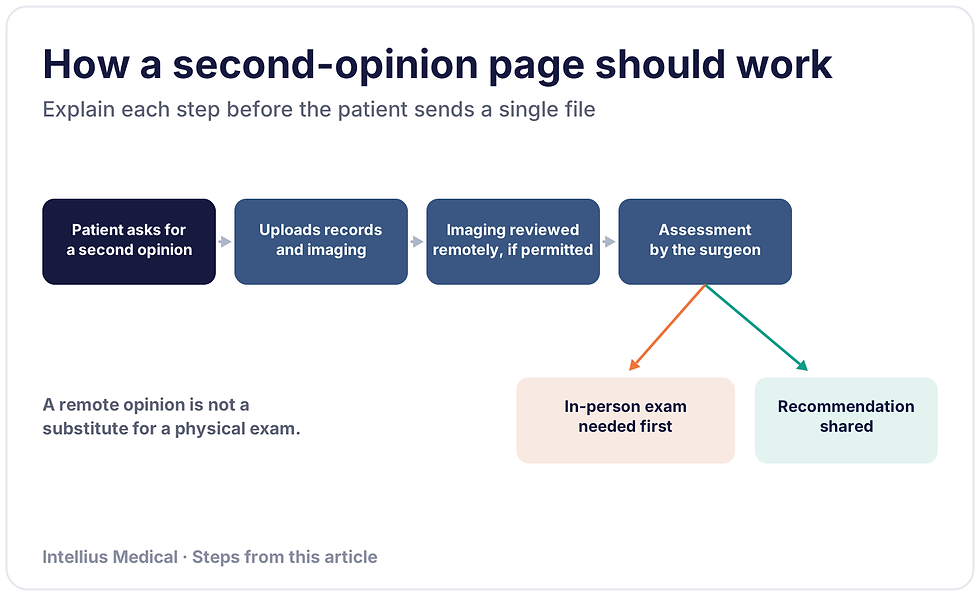
A separate second opinion page can be used to describe the process, the types of records that will be needed, whether imaging can be reviewed remotely, and what will happen following the assessment.
Example: New York Spine Institute lets patients upload imaging for a second opinion.
Spine marketing for second opinions: what the page should explain | |
Item | What to tell the patient |
The process | Each step, from request to recommendation |
Records needed | The types of records to send |
Remote imaging review | Whether imaging can be reviewed remotely |
After the assessment | What happens next |
In-person exam | When one is needed before a recommendation |
Remote Reviews and Their Limits
In places that are legally and clinically permissible, the practice can provide remote consultations or imaging reviews to patients residing outside the surgeon's area. A remote opinion, however, is not a substitute for a physical exam, and some patients will require an in-person exam before a treatment recommendation can be made.
Across state lines, the surgeon usually needs a license in the state where the patient is located, or another pathway that state allows.
Key takeaway: A second-opinion page is spine marketing that reaches patients before they travel. Be clear about what can be done remotely.
Building a Funnel for Out-of-Town Patients Across Texas
Make Care From Another City Manageable
Trying to get patients from a different city, such as Lubbock or Midland, is just the beginning. The practice should also ensure that the process of receiving care is manageable.
The key to an effective system is displaying adequate information about the surgeon and about the procedure. Patients can then book a consultation, upload relevant records securely, and find out if they can have a consultation remotely.
If the Patient Has to Travel
If traveling is necessary, the practice should inform the patient about the probable order of appointments, what the patient will need to bring to the appointment, and post-hospitalization treatment after the patient leaves home. Staff may also be able to offer practical advice on local transport and nearby accommodation (where applicable).
Example: Desert Institute for Spine Care lists nearby hotels with patient rates.
Our Dallas plastic surgeon client does this with out-of-town patient guides. Patients fly in from Houston and beyond for her 24-hour recovery protocol.

Follow-Up After the Patient Goes Home
Follow-up planning is particularly important. Post-surgical appointments, rehab and coordination with local healthcare providers may be needed for spine surgery. Patients should be aware of these arrangements before travelling.
The process of designing this patient journey helps to minimize uncertainty and make it easier for people to think about care that is not local to them.
Out-of-town spine surgery marketing checklist | |
Stage | What the practice explains |
Before travel | Surgeon and procedure information, booking, secure record upload, remote consultation |
The trip | Order of appointments, what to bring, local transport, nearby accommodation |
Surgery | Post-hospitalization treatment |
Back home | Post-surgical appointments, rehab, coordination with local providers |
Key takeaway: Spine surgery marketing for out-of-town patients works when the whole trip feels manageable before they book.
Showing Experience and Outcomes Without Overpromising
Proof of a Spine Surgeon's Experience
Spine patients seek proof of a surgeon's experience and expertise. A website should therefore do more than just say they're experienced or highly skilled.
Possible helpful information to communicate your areas of expertise may be your records of your surgeon training and qualifications, procedures performed, research presentations, and training videos. If reliable information is available, the practice may also share information that is appropriate and presented correctly regarding your surgical volume and outcomes.
Patient Stories and Short Videos
Patient stories can illustrate a treatment pathway, from the problem and the consideration of different options, through to the treatment and recovery. However, these need to be authentic, relevant and not give the impression that the patient will achieve the same results.
Short videos are a great way to add a personal touch. From your perspective as a surgeon, you can explain spinal fusion, difference between disc replacement and fusion, or some questions patients should ask themselves.
Example: Dr. Zayed Almadidy explains spine surgery to 1M+ TikTok followers.
The goal of all these is to show knowledge and tell the truth, not to guarantee a cure.
Texas has a rule for this. The Texas Medical Board's advertising rule (22 TAC §164.3) bans offering a permanent cure for an incurable disease, and a patient testimonial needs a credentials disclaimer and a disclosure of any compensation.
Texas Medical Board rules for spine surgeon marketing (22 TAC §164.3) | |
What you publish | What the Texas rule says |
Patient stories and testimonials | Disclaimer about the person's credentials |
Paid or rewarded testimonials | Disclose the compensation |
Back pain “cure” claims | No permanent cure for an incurable disease |
Board status | No “board eligible” wording that sounds like “board certified” |
Volume and outcome claims | Nothing false, deceptive or misleading |
Source: 22 Tex. Admin. Code §164.3 (Texas Medical Board).
Showing a spine surgeon's experience without overpromising | |
Show | Avoid |
Training and qualifications | Just saying "experienced" or "highly skilled" |
Procedures performed, research presentations | Volume or outcome claims without reliable data |
Authentic, relevant patient stories | Implying every patient gets the same result |
Short explainer videos from the surgeon | Promising a cure |
Key takeaway: In spine surgeon marketing, show knowledge and tell the truth. Patients notice a guarantee, and distrust it.
Referral Sources: Pain Physicians, Chiropractors and Physical Therapists
Who Refers Spine Patients
Even though digital marketing plays a significant role, the referral process still remains tightly connected to the branch of spine surgery.
When patients seek out evaluation of their spine, they may appear before pain management doctors, primary care doctors, chiropractors, physical therapist, and specialized doctors, among others, with a spine surgeon. Maintaining the nice relations with these caregivers may help the suitable sufferers discover the proper surgeon.

A Referral Site That Makes It Easy
A site for referral can help support them by letting you share details about the conditions and procedures you treat, make it simple for them to transmit records and schedule appointments, and allow easy access to referral info.
Example: Mid-South Spine Center gives referrers a spine navigator and records fax.
What referring providers need from a spine surgeon | |
They need | Give them |
To know what you treat | Conditions and procedures you treat |
To send records | A simple way to transmit records |
To book the patient | Easy appointment scheduling |
To find your referral info | Easy access to referral details |
To hear back | Appropriate updates, with consent and privacy rules followed |
Communication After the Referral
It is important to communicate appropriately post referral. Providers should be notified appropriately and patient consent and privacy requirements should be adhered to. A good referral process will help establish and maintain long term relationships.
Key takeaway: Online marketing for spine surgeons supports referral relationships. It doesn't replace them.
Local SEO in a Crowded Texas Metro
Competing With Hospital Systems
Spine surgeons practicing in metropolitan areas such as Dallas–Fort Worth or Houston have to battle hospital systems, the well-established practice and competing specialists for placement in search engine rankings.
What Local SEO Includes
For prospective patients looking for a surgeon in a certain area or city, local SEO is an effective way to assist them. This consists of verified business information, valid contact and patient reviews, advantageous neighborhood related content, and a website that lays out location and service type.
Google says local results are based mainly on relevance, distance and prominence.
It can be done next door to a big metro. Our Mansfield, Texas pain management client competed with Dallas pain doctors who had 100+ Google reviews. He now gets 150–200 calls a month from Google, with no ads.
Specific Searches Beat Generic Ones
In spine surgeon marketing, it's sometimes better to not go with the generic. For example, "spine surgeon" may not be the top search for every patient. More targeted searches for things like procedures, conditions, second opinions, or where they are located may catch the attention of a searcher with a specific goal in mind.
Spine surgeon SEO: generic vs. specific searches | ||
Search type | Example | What the searcher wants |
Generic | spine surgeon | Any specialist; hospitals compete hard |
Procedure | artificial disc replacement | A surgeon who does that procedure |
Condition | herniated disc treatment | Options for a known diagnosis |
Second opinion | second opinion spinal fusion | Another specialist's view |
Location | spine surgeon Plano or Katy | A surgeon in a certain area |
Keep the Surgeon's Name Distinct
The name of the surgeon should be legibly distinct from the name of the hospital/ organization to which the operator belongs.
Example: Becker's covers Dr. Todd Lanman by name, not by his hospital.
Key takeaway: Spine surgeon SEO wins on specific searches first: procedures, conditions, second opinions and location.
Spine Surgery Ads: Which Searches Are Worth Paying For?
Not Every Spine Search Deserves the Same Budget
For a spine surgeon, paid search ads can be a great way to attract patients who are actively searching for spine care. But not all searches can be allocated the same budget.
Specific procedures, spine doctors, or second opinions may be more indicative of intent than general searches for back pain. While broad terms can be useful, they can also draw in individuals who are looking for general information and not specialist care.

Landing Pages and the Numbers That Count
Patients should be directed to relevant procedure or consultation pages rather than directing everyone to the home page. Qualified inquiries, booked consultations, completed appointments and surgical cases with attribution should be used to measure results.

Spine marketing metrics: what to track in ads | |
Measure | Why it matters |
Qualified inquiries | Right patient, right condition |
Booked consultations | Intent turned into a visit |
Completed appointments | The patient actually came |
Surgical cases with attribution | What the ad was really worth |
Health Data Rules in Ad Platforms
Advertising regulations and policies for healthcare platforms also apply, especially regarding the processing of sensitive health data.
On Google Ads, health is a sensitive category: advertisers can't use their own audience lists, such as customer match, for health-related ads.
Key takeaway: In paid spine surgeon marketing, pay for searches that show intent, and send each one to its own page.
What Spine Surgeon Marketing Costs in Texas
What Drives the Price
The price will vary based on the surgeon's location (Dallas and Houston are more crowded than Waco), competition, objectives, and online presence. The needs of a surgeon who requires a professional website and a few procedure pages will be different than the needs of a practice that's launching a multi-location campaign with paid advertising, video, second opinion services, and continuous SEO. Intellius plans for Texas practices start at $900 a month.
Spine surgeon marketing needs, small vs. large | ||
A surgeon starting out | A multi-location practice | |
Website | A professional website | Website plus continuous SEO |
Pages | A few procedure pages | Procedure pages plus second-opinion services |
Channels | Organic and local search | Paid advertising and video too |
Start With the Highest-Paying Opportunities
In spine surgeon marketing, the first thing to do is to start with the highest-paying opportunities. This can be anything from making improvements to the website, creating pages for priority procedures, enhancing local search visibility, or improving the consultation process.
Keep or Adjust: Let the Evidence Decide
Spine surgeon marketing spend should be based on evidence over time. If a campaign generates qualified consultations and appropriate surgical cases at a sustainable cost, it may be appropriate to continue investing in the campaign. If it drives traffic but fails to bring in any relevant patient enquiries, then the strategy must be adjusted.

Spine Surgeon Marketing in Texas: FAQs
How do spine patients find a surgeon?
Patients usually discover spine surgeons through doctor referrals, recommendations, hospital Web sites, Internet searches, physicians’ directories and patient reviews. Many individuals look up a surgeon's experience and treatment methods prior to scheduling an appointment.
Should a spine surgeon offer online second opinions?
It might be a helpful service for some patients, such as those who live a distance away, such as in West Texas or want a second opinion before surgery. The practice should explain to the patient what files will be reviewed, how much of them, and when an in-person exam is necessary.
How do we attract out-of-town spine patients?
Generate procedure pages and surgeon credentials, make sure second opinion (if needed) is included, and make clear how remote consultation, travel, treatment, and follow-up work. Patients require some things that relate to the clinic experience and other things that relate to practical advice.
Which spine procedures should get their own page?
Focus on the steps the surgeon actually does and desires to develop. They can be anything from artificial disc replacement to endoscopic spine surgery, minimally invasive fusion, SI joint procedures and more.
Do chiropractors still refer spine?
Yes. These providers can continue to be valuable referral sources. Relationships and good communication between providers should be encouraged and not supplanted by online marketing.
How long does spine surgeon SEO take?
Some enhancements, like fixing business data or enhancing existing pages, may be advantageous quicker. It can take several months or even longer to achieve good organic search visibility, depending on the competition, website quality and the effort involved.
Can a spine surgeon rank above hospital systems?
Yes, for some searches. A targeted site that offers good procedure information, relevant expertise, and accurate local information and patient resources can compete for specific searches. But no agency can guarantee to be ranked higher than the big hospital systems.
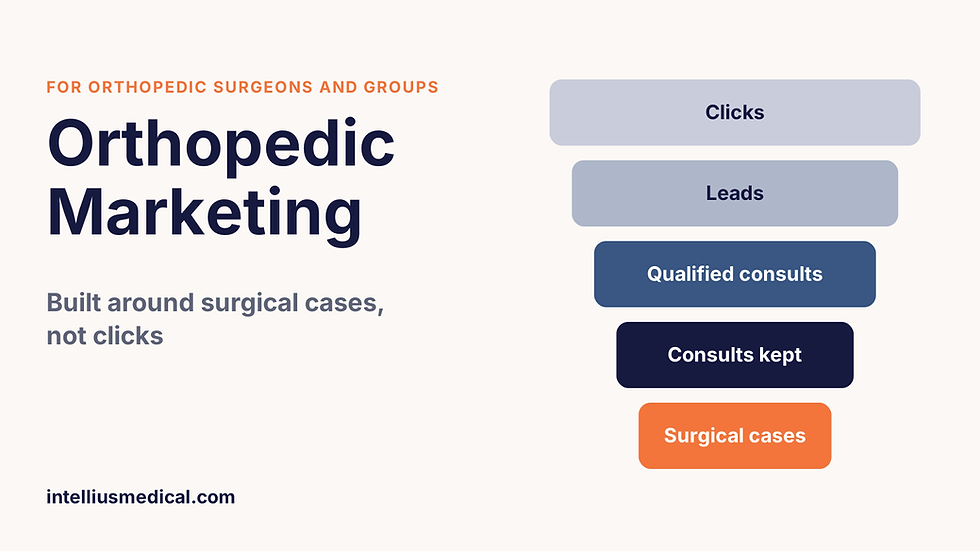
For the orthopedic side, see our orthopedic marketing playbook.