Personal Branding for Orthopedic Surgeons in Texas: Asked for by Name

Updated: 4 days ago
In orthopedics, from Dallas to Houston, patients don't always choose a practice. Instead, they choose a surgeon.
The name of the surgeon may be heard from the referring primary care doctor, the patient's relatives, a physical therapist, a colleague, or a friend.
Afterward, the patient will then search the name of the surgeon on Google to get more information about the surgeon before deciding to schedule an appointment. Whatever the patient discovers during that search determines whether he or she will reach out to the surgeon or not.
If the information the patient reads on the surgeon’s page are outdated or irrelevant, or there isn’t enough information about the surgeon, it means the patient has limited information to make a decision.
In contrast, if the surgeon’s website or page is professionally outlined with detailed and useful information about the surgeon, including the surgeon’s specialty, experience, procedures offered, location, patient education resources, and reputation, then the patient has all the information he or she needs to make an informed decision.
This is why personal branding for orthopedic surgeons isn't just a way to get more visibility and followers online. For an orthopedic surgeon in Texas, personal branding is also about ensuring that patients can easily get detailed and valuable information about you in order to make informed decisions about whether or not to book an appointment.
In a Doctor.com survey of 1,700 adults, 81% said they read provider reviews even after a referral, and 63% would choose one provider over another based on online presence.
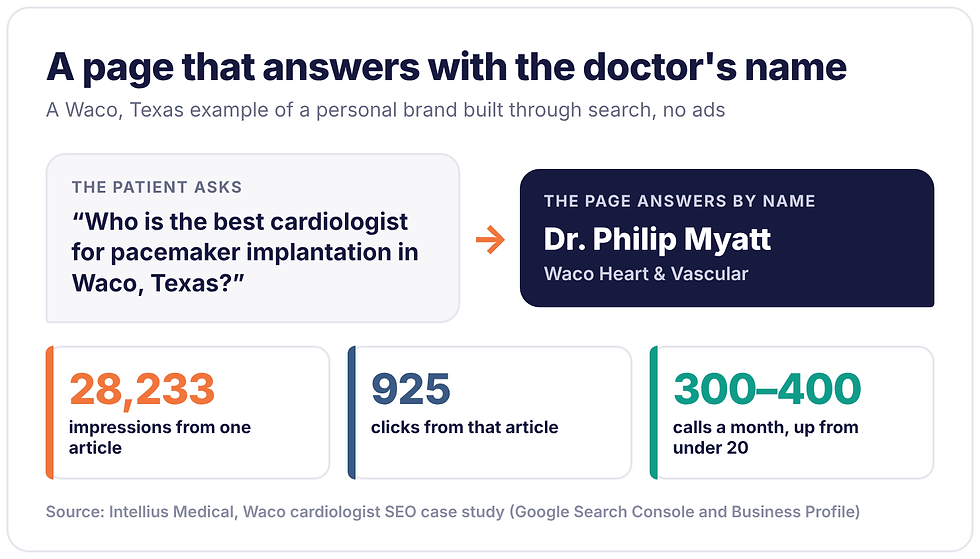
Proof from Texas: our Dallas plastic surgeon has her name on a site with 537 indexed URLs. Each month, about 150 people who did not know she existed find her through organic search and call, with no ads. That is a surgeon's personal brand doing the work.
Texas proof: what a doctor's name can bring in | ||
Practice | Metric | Result |
Dallas plastic surgeon | Patient calls a month | About 150, from organic search |
Dallas plastic surgeon | Indexed URLs | 537 |
Waco Heart & Vascular | One article that answers by name | 28,233 impressions, 925 clicks |
Waco Heart & Vascular | Calls a month | 300–400, up from under 20 |
Both | Paid ads | None |
Source: Intellius Medical case studies, Dallas plastic surgery and Waco cardiologist.

Why the Surgeon's Name Is the Most Valuable Marketing Asset
A practice can have another name. The ownership of a hospital may be changed. A surgeon may switch to another hospital in Dallas or Houston, but the name of the surgeon remains unchanged.

What an Orthopedic Surgeon's Name Carries
As an orthopedic surgeon, your name is your identity. That is what people, including patients, colleagues, friends, and doctors from other medical establishments will easily use to identify you. Your name is your most valuable marketing asset because it is largely your brand’s identity. Your name carries your expertise, specialty, qualifications, experience, and reputation.
A Long-Term Asset for Your Career
As a surgeon, it is best to promote your name both online and offline so that more people will know you and easily identify you by your name. This will help bring in more patients to your practice. This equates to a long-term asset to your marketing efforts. The goal isn't to take the place of the hospital. It is to develop recognition that will serve you throughout your career.
Key takeaway: Personal branding for orthopedic surgeons builds on the one asset that never changes employers: your name.
What Texas Patients Find When They Search Your Name Today
When patients in Plano or Katy search your name online, they should be able to find detailed information about you and what you do. Patients who search for you online want to know whether or not you’re the right surgeon for their conditions. They want to know if you’re qualified and if you have the right experience and expertise to attend to their concerns.
What Belongs on an Orthopedic Surgeon's Page
On your website or practice page, patients should be able to find;
Where you’re located
The qualifications you have, including specialty
Licenses and certifications
Training and fellowships, including years of experience
The list of conditions you treat and procedures you perform
How to book an appointment and contact address
All these information and more should be well-outlined on your website or practice page for easy access.

What patients look for when they search an orthopedic surgeon's name | ||
What they look for | Where it goes | The question it answers |
Where you're located | Location pages, Google profile | Can I get there? |
Qualifications and specialty | Homepage and bio | Is this the right surgeon for me? |
Licenses and certifications | Bio page | Is this surgeon qualified? |
Training, fellowships, experience | Bio page | Has this surgeon done this before? |
Conditions and procedures | One page per procedure | Does this surgeon treat my problem? |
How to book, contact address | Every page | How do I get an appointment? |
Employed vs. Independent Surgeons
A surgeon's employment status has an impact on his or her control over his or her website.
Independent Surgeons
An independent surgeon typically has more flexibility in developing a website, branding, educating patients, advertising, and managing the patient experience. He/she can manage his/her website and include the information he/she wants to include. There are no restrictions of any kind.
Employed Surgeons
An employed surgeon works for an organization and is under the rules and regulations of the organization. Restrictions may be placed by the leadership of the organization. The organization reserves the right to manage the official website, advertising, social media, and online presence of the surgeon.
What an Employed Surgeon Can Still Do
However, this does not imply that employed surgeons cannot develop a personal brand. A surgeon can still establish an accurate professional profile, provide educational materials, be available for interviews, publish content, attend conferences, etc. What's important is to know the terms of the job contract and the marketing policies of the organization to avoid doing anything that could be against the rules of the organization.

Employed vs. independent surgeons: who controls the personal brand | ||
Area | Independent surgeon | Employed surgeon |
Website | Builds and manages it | Organization manages the official site |
Branding and advertising | Full flexibility | Set by the organization's leadership |
Social media | Own accounts | Official accounts run by the organization |
Professional profile | Yes | Yes, within contract and policy |
Publishing, interviews, conferences | Yes | Yes, within contract and policy |
Key takeaway: Employed or independent, an orthopedic surgeon can build a personal brand. Read the contract and marketing policy first.
What Happens to Your Patients When You Change Groups?
This is one of the best reasons to establish a personal brand early.
The Surgeon Who Leaves After 10 Years
Imagine a Houston surgeon who has worked in an organization for 10 years as part of an orthopedic group. Then, the surgeon changes or leaves the group or organization entirely. If the surgeon doesn’t have good personal branding and is not well-known, he/she will end up losing patients (both existing and new).
If all the surgeon's online presence is from the previous organization, patients will most likely go to the previous organization rather than the surgeon's new group or organization.
For example, if a surgeon leaves an organization he has worked for over 10 years and goes on to establish his own practice or hospital, he will end up losing all his previous patients if he doesn’t have his/her own personal branding or identity.
Continuity Without a Rebuild
The surgeon doesn't need to rebuild their entire online identity from scratch to update the new location, contact information, procedures, and other details. It involves creating a professional digital footprint that is completely dependent on an employer's control. Properly managed personal branding and identity create continuity.

Key takeaway: A surgeon's personal brand moves with the surgeon. The group's web page stays with the group.
Your Own Website: What Should Be on It?
The Homepage
A surgeon's web page ought to respond to the inquiries that a patient may have before they make an appointment. The main areas of practice, locations (such as your Frisco or Sugar Land office), the surgeon's name, and specialty should be clearly displayed on the homepage. Specific pages can provide instructions and requirements in terms that patients can understand.
The Pages Behind It
A professional biography, education and training, certifications, hospital affiliations, publications, speaking experience, patient resources, frequently asked questions, and clear steps to book appointments should also be included.
Who Registers the Domain
The domain is also vital. Ideally, the surgeon should be the one who registers the domain, not an employer or marketing agency. The domain is a long-term investment property. The surgeon should not be forced to begin again when an agency relationship or employment contract is terminated.
Personal brand website checklist for orthopedic surgeons | |
Section | What goes in it |
Homepage | Name, specialty, main areas of practice, locations |
Biography | Professional biography, education and training, certifications |
Affiliations | Hospital affiliations |
Authority | Publications and speaking experience |
Patient resources | Patient resources and frequently asked questions |
Booking | Clear steps to book appointments |
Domain | Registered by the surgeon, not an employer or agency |
Key takeaway: Register the domain in your own name, not your employer's or your agency's.
Claiming and Fixing Physician Profiles, Texas Medical Board Included
Healthgrades, WebMD, Vitals and Doximity
When patients search for a surgeon's name, the physician directory is likely to be prominently displayed. Therefore, Healthgrades, WebMD, Vitals, and Doximity can have a significant impact on a patient's initial impression.
These profiles should be updated on a regular basis to ensure that the information is correct. When available, the surgeon's name, specialty, education, locations, hospital affiliations, credentials, and other professional information should be consistent.
In Texas, patients can also look you up on the Texas Medical Board's Check Your Healthcare Provider database. Licensees submit some of that data, so keep your practice address and specialty current there too.

Small Errors That Cost Bookings
Outdated phone numbers or an old Dallas or Fort Worth practice address may appear to be a minor issue, but it can cause confusion when a patient is considering booking.
Physician directories that shape a surgeon's personal brand | ||
Directory | Who reads it | Check first |
Healthgrades | Patients comparing doctors | Specialty, locations, phone |
WebMD | Patients searching conditions and doctors | Name, education, affiliations |
Vitals | Patients reading ratings | Locations, credentials |
Doximity | Physicians, including referring doctors | Specialty, hospital affiliations |
Key takeaway: Make the facts on every directory profile match your own site.
Turning Cases, Lectures and Publications Into Patient Content
There is already a wealth of information that surgeons can use as patient content.
From Lecture to Patient Page
A conference presentation can become patient content discussing a common orthopedic problem. A research article can be translated into an easy-to-understand interpretation of what it says. A common procedure can be a set of educational pages explaining what to expect, risks, and how to prepare.

Write for Patients, Not Peer Review
People searching for treatment in the field of orthopedics shouldn't require a research paper with esoteric medical terms that takes forever to decipher. They want to know what the problem is, when they will require treatment, how the treatment will go, and what they need to be asking their doctors. All the cases, lectures, and publications of a surgeon can all be turned into content for patients to help them with a better understanding of various information that they may be searching for.
Our Manhattan facial plastic surgeon shows how far this goes: 78,000 words of surgeon-reviewed content, peer-reviewed references on 42 of 48 procedure pages, and 100+ new patients a month from organic search.
Closer to home, our Waco, Texas cardiologist client's site answers “Who is the best cardiologist for pacemaker implantation in Waco, Texas?” with his name. One article drew 28,233 impressions and 925 clicks, and calls went from under 20 to 300–400 a month, with no ads.
Turning a surgeon's work into patient content | ||
What you already have | What it becomes | What patients get |
Conference presentation | Article on a common orthopedic problem | The problem in plain words |
Research article | Easy-to-understand summary | What the research says |
Common procedure | Set of educational pages | What to expect, risks, how to prepare |
Cases | Condition and treatment pages | When treatment is needed and how it goes |
Video From the Surgeon: Short Answers Work
Patients are interested in hearing from the person who might treat them. It doesn't need to be a costly production or long lecture.
Questions Worth a Short Video
Many times, it helps to have a brief video of you answering the most common FAQs from your patients. As a surgeon, you may talk about how you know when knee pain needs to be addressed, what would be done with your hip replacement, when you would refer back pain to the specialist, what to expect after a certain procedure, e.t.c.

Keep It Clear and Accurate
The face, voice, and explanation of the surgeon add something that a written profile simply cannot. The videos should be clear, professional, and educational. All the information you provide should be accurate. You should not make promises or claims that are not substantiated.
Key takeaway: Short answers on camera give an orthopedic surgeon's personal brand what a written profile can't.
Reviews That Name You, Not Just the Practice
There can be hundreds of reviews of a practice, but patients are interested in what others have to say about the surgeon themselves.
Reviews That Mention the Surgeon by Name
If patients voluntarily leave reviews, with an accurate description of their experience and the surgeon's name, they can bolster the surgeon’s reputation. Practices should solicit authentic patient reviews, bearing in mind platform guidelines and the rules of the healthcare privacy landscape.
The Rules That Apply in Texas
The FTC's 2024 rule on reviews bans fake reviews and incentives that depend on a review being positive. In 2019, a Dallas dental practice paid HHS $10,000 over patient information it disclosed on social media.
Texas adds its own rule. Under the Texas Medical Board's advertising rule (22 TAC §164.3), a testimonial needs a disclaimer about the person's credentials and a disclosure of any compensation.
Texas rules for a surgeon's personal brand: reviews and testimonials | |
Situation | What to do |
Quoting a patient review on your site or in an ad | Add a disclaimer about the person's credentials |
Patient got a discount or gift for it | Disclose the compensation |
Outcome claims | Nothing false, deceptive or misleading |
Talking about results | Never offer a permanent cure for an incurable disease |
Replying to a review | No patient details, even if the patient shared them |
Practice reviews vs. reviews that name the surgeon | ||
Practice reviews | Reviews that name the surgeon | |
What they describe | The office and the visit | The surgeon's care |
Who they help | The group | The surgeon, at any group |
Where they live | The group's profiles | Profiles in the surgeon's name too |
Key takeaway: Ask for authentic reviews that use the surgeon's name, and never reply with patient details.
Example: Building a Neurosurgeon's Personal Brand Site in Tampa
Let's take the case of a neurosurgeon who's widely recognized in the medical field but not well known by the general public online, such as one in Tampa.
What Patients Find Today
Patients looking up the surgeon's name will see a profile of the hospital, an old directory listing, and a page of the group with a brief bio.

The Personal Brand Site Plan
Though, a surgeon's individual branding plan will begin with creating a website about the surgeon instead of their present employer. The information on the site should include the surgeon's main areas of specialty, major procedures offered, relevant publications and presentations, associated medical organizations, and appointment details.
The surgeon may also put together short educational videos addressing common queries.
When the Surgeon Moves
If the surgeon later moves to another practice in Tampa, the personal website remains a central point of reference. The location, affiliations, and appointment details may change without losing the overall identity that has already been established. The true power of personal branding for orthopedic surgeons is that the reputation of the surgeon goes with him/her, not the employer.
Key takeaway: The site, the domain and the profiles stay with the surgeon through every move.
Personal Branding for Orthopedic Surgeons in Texas: FAQs
Can an employed surgeon build a personal brand?
Yes, depending on the terms of the employment contract and organizational policies. A personal brand can include professional education, publications, speaking engagements, accurate directory profiles, and appropriate social media activity.
Will my group let me have my own website?
This is dependent on the organisation. Some groups sponsor physician websites, and others want physicians to use the group's website. Review the employment agreement and discuss the plan with appropriate leadership before launching one.
Does a personal site compete with the practice site?
It doesn't have to. A practice website can be used to showcase the group, its locations, and its general services, while the surgeon's website can offer more in-depth information about the individual surgeon. When the information is accurate and well connected, the two can help each other.
Who should own my website domain?
It is best if the surgeon owns and controls the domain. The website can be managed by a marketing agency, but the domain should be owned and kept by the surgeon.
How long does it take to build a personal brand online?
It can be built in a relatively short amount of time, but reputation and search visibility will take time. The key to building a strong personal brand is to provide consistent practice information, accurate profile information, and allow patient reviews. Also, consistently provide useful medical content online so that more people can get to know you and what you offer.
Should I be on social media as a surgeon?
It is very important to be on social media as a surgeon. Over 5 billion people use social media worldwide. You can quickly increase your visibility and brand using social media. Social media platforms like Facebook, Instagram, X, and LinkedIn are all great platforms to increase your visibility.
What should I do first if I'm leaving my group next year?
First, identify what is yours and what is ours, according to your group.
Subsequently, sign up for your specialist domain if suitable, double-check your physician directory profiles (including the Texas Medical Board), write down a specialist profile, and make sure that your future contact and location are easily changeable. Ensure that you have ownership of your domain and can manage your page yourself.

How much does personal branding cost for a surgeon?
The fee is dependent on the amount of work needed. Intellius plans for Texas surgeons start at $900 a month. A simple professional website can be a fairly inexpensive investment. A complete personal branding package can include custom website development, search optimization, professional photographers, video productions, content creation, directory management, and reputation management. All of these cost money and will definitely increase your personal branding cost.
What a complete surgeon personal branding package can include | |
Part | What it covers |
Custom website development | Your own site on a domain you own |
Search optimization | Showing up when patients search your name and procedures |
Professional photography | Headshots and practice photos |
Video production | Short answers to common patient questions |
Content creation | Procedure, condition and FAQ pages |
Directory management | Accurate Healthgrades, WebMD, Vitals and Doximity profiles |
Reputation management | Asking for and answering reviews |
For the practice side of growth, see our orthopedic marketing playbook.