Orthopedic Marketing: A Playbook Built Around Surgical Cases, Not Clicks

There's a measurement issue with orthopedic marketing.
There are still many practices that evaluate their marketing based on the number of visitors on their site, the number of impressions, their ranking, the number of clicks, or the number of leads they get each month.
While those numbers may be helpful, they don't really answer the question that an orthopedic practice really wants to answer: Did marketing efforts increase the number of patients who were eventually surgical cases?
If a hundred forms are submitted, but most of them are irrelevant, then it is of little value. If a couple of the ten new consultations become high-value cases, such as joint replacements, spine surgery, sports surgery, etc., then the ten are worth much more.
Therefore, marketing for orthopedic practices must focus on the entire patient journey, from their initial search to their consultation and finally, the surgical procedure.
What Orthopedic Marketing Should Produce: Surgical Cases, Not Leads
Two Patients, Same Search
A lead isn't the end result.
Someone might search for knee pain, call orthopedic offices, fill out a web form, and then decide not to make an appointment. Someone else could search Google for a surgeon, make an appointment, get a diagnosis, and then have a surgery.
The second patient is the one that counts.

The Four Questions That Matter
This alters the marketing approach of an orthopedic practice. Rather than asking “How many leads did we generate?” the more important questions are “How many consultations came from marketing?” How many of those patients were surgical candidates? What was the number of surgeries? What marketing channel did those patients come from?

Making attention is not the objective. It is to provide a secure route to search from appointment to treatment.
Track Orthopedic Marketing in Cases, Not Clicks

Orthopedic marketing metrics: what to track instead | |
What many practices track | What to track instead |
Website visitors | Qualified consultations |
Impressions and rankings | Consultations that took place |
Clicks | Surgical cases from marketing |
Leads per month | Cost per surgical case |
Cost per lead | Source of each surgical case |
Key takeaway: Judge orthopedic marketing by consultations and surgical cases, not by clicks or leads.
Why Orthopedics Is Different
A Long Decision Cycle
The process of deciding on orthopedic care may take longer than many other medical services. A patient may have pain for a number of months before seeking help.
Then, the patient would go and research different surgeons, read reviews, figure out insurance coverage, research treatments and talk the entire surgery over with family members before even making an appointment.

Many Subspecialties, Many Patients
There are also several subspecialties within orthopedics. Someone seeking a hip replacement is not necessarily seeking the same surgeon as a person seeking ACL reconstruction surgery, carpal tunnel surgery, spinal fusion surgery or foot and ankle surgery.
Referrals Still Shape the Path
Referral networks are another level. Several factors can affect the type of orthopedic care that a patient receives, including primary care physicians, physical therapists, other specialists, hospitals, and current patients.
These referral relationships need to be complemented by effective marketing, not supplanted.

Key takeaway: Orthopedic patients decide slowly, by subspecialty, and often through referrals. Orthopedic marketing has to support all three.
The Case Math: What One Surgical Patient Can Be Worth
When the economics of orthopedic marketing are examined in terms of the value of a patient over time, it becomes clear.
One Knee Patient, Many Visits
Let's take an example of a patient who started with an orthopedic physician for chronic knee pain.
The initial visit may result in imaging, conservative care, further visits, and ultimately a total knee replacement.
That patient may also come back years later with another orthopedic problem.
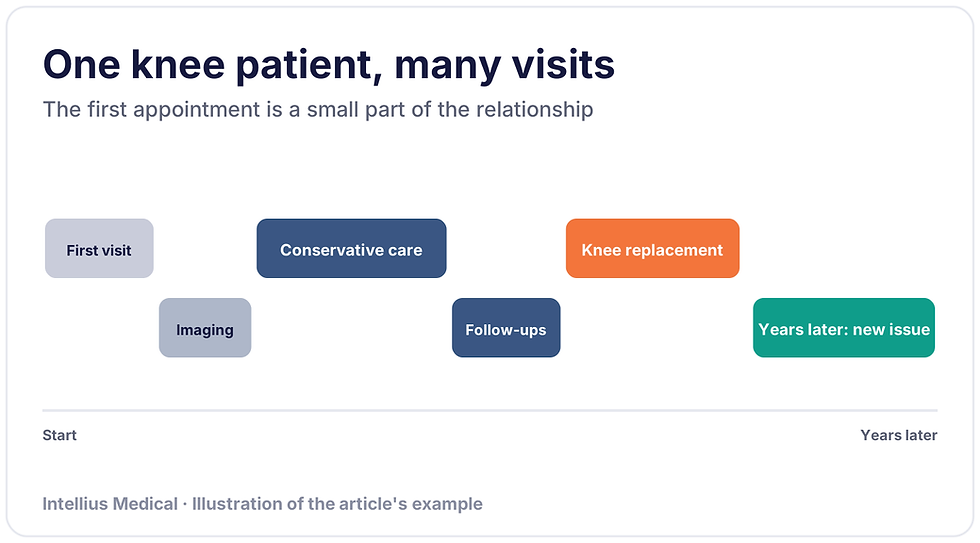
The value of that relationship is therefore much greater than that of the revenue that's associated with the first appointment.
The Volume Behind Joint Replacement
According to the AAOS, more than 700,000 total knee replacements and more than 450,000 total hip replacements are performed in the US each year.

Cost per Case Beats Cost per Lead
That is why an orthopedic practice shouldn't dismiss a marketing campaign based on what they think the cost per lead is.
The more useful calculation is the cost per qualified consultation and ultimately cost per surgical case.
Marketing might be doing very well even if the number of leads seems low, if it's generating 10 qualified consultations and 2 of those consultations lead to surgical cases that bring in revenue.
Orthopedic marketing math: cost per lead vs cost per surgical case (example) | ||
Stage | Example count | What it tells you |
Form fills and calls | 100 | Interest, not intent |
Qualified consultations | 10 | Right condition, right surgeon |
Surgical cases | 2 | What marketing is really worth |
Key takeaway: One surgical patient can mean years of visits. Measure orthopedic marketing by cost per case, not cost per lead.
Marketing by Subspecialty
Orthopedic marketing is more effective when it aligns with the things people are seeking.

Joint Replacement
A campaign for joint replacement should be directed at those considering having a hip or knee replacement.
Spine
Another campaign on spine should include herniated disc, spinal stenosis, and back pain, and should address when diagnosis by a specialist is indicated.
Sports Medicine
Sports medicine can be dedicated to injury, recovery, and return to activity.
Hand Surgery
Hand surgical campaigns are useful for treating carpal tunnel, trigger finger, and fractures.
Foot and Ankle
Foot and ankle campaigns can be dedicated to bunions, Achilles issues and other common conditions.
The idea is not to develop five iterations of the same generic orthopedic campaign. Patients, procedures, questions, competitors, and search behaviour vary between subspecialties.
Orthopedic marketing by subspecialty | ||
Subspecialty | Conditions and procedures | Page to build |
Joint replacement | Hip and knee replacement | A page per joint, surgeon and location |
Spine | Herniated disc, spinal stenosis, back pain | Condition pages on when to see a specialist |
Sports medicine | ACL tears, injuries, return to activity | Injury and recovery pages |
Hand | Carpal tunnel, trigger finger, fractures | Condition and procedure pages |
Foot and ankle | Bunions, Achilles problems | Condition pages with treatment options |
Key takeaway: Build a separate orthopedic marketing campaign for each subspecialty you want to grow.
The Surgeon's Name vs. the Group's Brand
When Patients Search a Surgeon's Name
Before looking for an orthopedic group or hospital, patients are likely to look for a surgeon. A person might enter a surgeon's name into Google search as a result of a friend's or doctor's referral.
When Patients Search a Procedure
Yet, another patient may look for a knee replacement surgeon without knowing the names of any.

Group Brand and Surgeon Presence
Both are required to have a strong strategy. The group needs to have an established and reputable brand and each surgeon needs to have a solid individual online presence.
Surgeon biographies, specialties, procedures, locations, credentials, patient reviews and appointment information should be readily available. A patient should be able to know everything about a surgeon when he or she types the surgeon’s name on Google search bar. This will help the patient make better informed-decision.
Key takeaway: Marketing for orthopedic surgeons should cover the group and every surgeon. Patients search both ways.
Procedure Pages: One Page for Each Surgery, Surgeon and Location
What Patients Want to Know
One page of "Orthopedic Services" is not sufficient. Patients are looking for specific procedures. They want to know who is going to do the surgery, where it is performed, what the procedure entails, what kind of recovery it entails and how to make an appointment.

Tie Every Page to a Surgeon and Location
This implies that pages that are useful around procedures and surgeons should be created in a practice. For instance, a knee replacement page should be associated with the right surgeon and place.

These pages are not about repeating keywords, but answering actual patient questions. They should also clearly point to the next step in the process, which is scheduling a consultation.
Key takeaway: Orthopedic practice marketing needs one page per surgery, surgeon and location, each ending with a clear way to book.
Google Business Profile for All Locations and Surgeons
Local search is particularly crucial for orthopedic practices. Patients often look for orthopedic surgeons, knee specialists, spine surgeons, or other orthopedic specialists in a specific area or city. A solid, well-kept Google Business Profile makes the practice more visible.
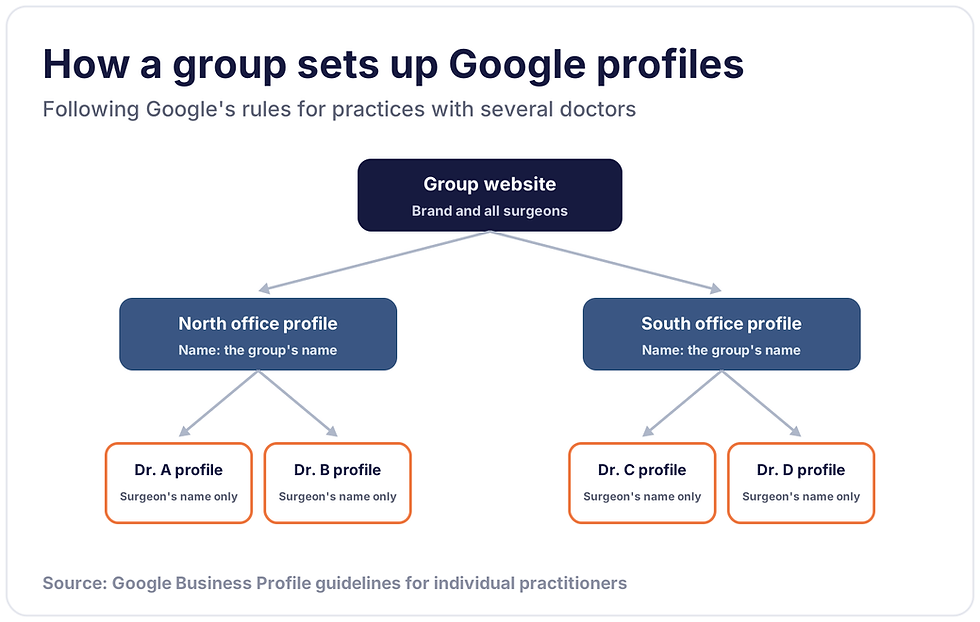
One Profile per Location
All legitimate practices should have an accurate profile that includes the right address, phone number, hours, services offered, website, pictures, and reviews.
Surgeon Profiles: What Google Allows
If applicable, each surgeon should also have a professional online presence. The information should be accurate and consistent throughout the practice website and other online listings.
Google's guidelines allow a surgeon their own profile if they are public-facing and can be reached at the location during stated hours. In a group, the surgeon's profile carries only the surgeon's name, while the group keeps its own profile.
Orthopedic practice marketing on Google: profiles for a group | ||
Profile | Name format | Must have |
Each office location | The group's name | Address, hours, phone, services, photos |
Each public-facing surgeon | The surgeon's name only | Specialty, hours at that office, reviews |
Solo surgeon practice | Brand: Surgeon name | One shared profile |
Why Reviews Decide Close Calls
A review page is very important. Most patients will check the review pages of different surgeons before making a decision. Patients can assess the experience and quality of service delivery of a surgeon by reading reviews from other patients who have previously had encounters with the surgeon.
Reviews are crucial, especially when multiple qualified surgeons are listed in the same search.
Maps calls add up for specialists. Our Waco heart and vascular client got 1,540 calls from Google Maps, and monthly calls went from under 20 to 300 to 400.
Key takeaway: Give every location, and every public-facing surgeon, an accurate Google profile with reviews.
Turning Calls Into Booked Consults
Where Calls Get Lost
If calls are not managed appropriately, an orthopedic practice can spend thousands of dollars attracting patient traffic and miss out on opportunities.
A patient might be uncertain and want to talk to someone before making a decision. When no one is picking up the calls, they keep getting to voicemail, or are not getting clear answers, they might call another practice.
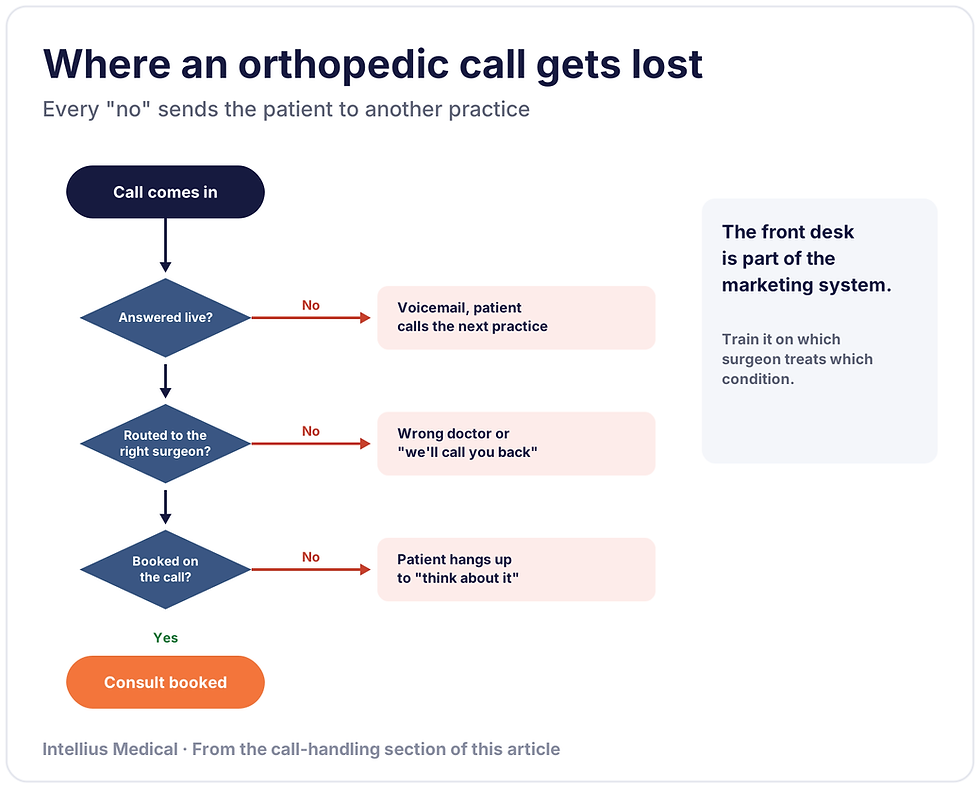
The Front Desk Is Part of Orthopedic Practice Marketing
The front desk is thus a component of the marketing system. Front desk personnel should be aware of which surgeon is right for which conditions, know the basic appointment procedure, be readily available to answer calls, and ensure that qualified patients can easily make appointments. Marketing performance should also take into account what happens after the inquiry.
What the orthopedic front desk must know | |
Front desk task | Why it matters |
Which surgeon treats which condition | Routes the patient to the right consult |
How to book a first appointment | No "we'll call you back" |
Answering live during office hours | Uncertain patients call the next practice |
Insurance and referral basics | Removes a common reason to wait |
Key takeaway: Every unanswered call is a lost consult. Train the front desk as part of the orthopedic marketing team.
What to Measure Each Month
The list below contains the items to measure each month.
The Five Core Numbers
For an orthopedic practice, reporting should relate marketing efforts to patients. The following should be included in the core numbers:
Qualified consultations generated
Consultations that took place
Surgeries due to marketing
Revenue or estimated value of such cases
The source of each patient

Know the Source of Every Case
The last one is especially significant. If a patient came from a Google search or an online ad, a surgeon's website, referral, or another source, the practice should be aware of that.
This allows you to allocate more resources to the channels that actually generate surgical cases over time.
Call conversion tracking shows which ad or page each call came from.
Key takeaway: If your orthopedic marketing report doesn't show surgical cases by source, it isn't measuring marketing.
What Orthopedic Marketing Costs and When Results Appear
What Drives the Cost
The cost of marketing can range from a few dollars to thousands of dollars and is dependent on the location, competition, number of surgeons, number of locations, and services being marketed.
A small practice may begin with a specific campaign for a single or two high-dollar procedures. For larger orthopedic practices, there are more sophisticated methods to consider, such as having multiple surgeons, multiple locations, multiple specialties, paid search, local search, content, reputation management, and conversion tracking.
A Realistic Six-Month Timeline
There is also no guarantee that the results will happen right away.
Month 1 - It's typically a period of research, monitoring, website optimization, Google Business Profile effort, and determining the best opportunities.
Months 2-3 - Pages and procedures, local visibility, paid campaigns (if applicable), and conversion systems are usually the top priorities during this period.
4–6 Months - Provides a more reliable indication of the channels that are generating qualified consultations, and which procedures are gaining traction.

Match the Plan to the Surgical Timeline
The important issue is that the time line must be compared to the orthopedic sales cycle. If a patient sees a surgeon today, he or she would not be able to go in for surgery for a few weeks or months.
So, the best marketing partner should concentrate on the patient journey, rather than promises of immediate surgical volume.
For channel-by-channel tactics, see our orthopedic advertising and marketing guide.
Key takeaway: Expect a clear read on which orthopedic marketing channels bring consults by months 4 to 6, with surgical cases following on the patient's timeline.
Orthopedic Marketing FAQs
How much does orthopedic marketing cost per month?
The costs vary based on the number of surgeons, location, competition, procedures promoted and if SEO, paid advertising, website, reputation management or all of these are included in the marketing campaign. You can expect to spend hundreds of dollars to thousands of dollars for your orthopedic marketing campaigns.
How long before marketing brings new surgical cases?
It varies. With some practices (particularly paid search), consultations can be made in a matter of weeks. When a case requires a surgical intervention, it will generally take longer because imaging, conservative management, specialist consultations, insurance approval and/or time to consider surgery may be required. This whole process should be taken into account in the realistic marketing plan.
Should we market the group or each surgeon?
Marketing both the group and each surgeon is important. The group must have a strong brand, but individual surgeons should be easily identifiable as well. Patients prefer to go to a specific surgeon for his or her specialty, reputation, experience, location, and knowledge in the procedure. However, the reputation and integrity of the brand will determine if patients will check for surgeons in the establishment.
Which orthopedic subspecialty is easiest to grow online?
There is no one subspecialty that is easiest to grow online. The level of demand and competition is different in various markets. The best place to look is typically by examining the search volume, competition, surgeon availability, procedure value, and practice's conversion rate.
Do orthopedic practices still need referrals if they market online?
Yes. Physician referrals and digital marketing can go hand in hand. Patients who are already looking for orthopedic surgeons can be reached through online marketing. However, referrals remain valuable, as they help medical providers direct patients to the right surgeons.
Is SEO or Google Ads better for an orthopedic practice?
There's no right or wrong. While Google Ads can generate visibility and consultations faster, SEO can create long-term organic visibility. Many practices use both, and then determine which channels are actually resulting in consultations and surgical cases.
How do we know which surgeries came from marketing?
You can know this by tracking your marketing campaigns. Marketing channels can be linked to calls, forms, appointment sources, website interactions, and patient intake information. Tracking patients’ journeys right from the start helps you know which surgery came from marketing.
What should an orthopedic marketing agency report every month?
The report shouldn't be just about clicks and impressions. It should include qualified inquiries, booked consultations, completed consultations, surgical cases, lead sources, campaign performance, and significant month-on-month changes.


