Surgeon Reputation Management: What 1-Star Reviews Really Say

Updated: 3 days ago
For surgeons, reputation management starts with replying to negative reviews quickly. Some of your patients will leave reviews on your review pages.
While most of the reviews may be positive reviews, some of the reviews may be negative reviews. Leaving negative reviews to remain on your review pages without addressing them adequately can harm the surgeon’s reputation and the practice behind it.
You need to quickly address negative reviews before they can harm the surgeon’s reputation. You don’t want potential patients to read reviews that can discourage them from seeking your services.
Patients looking for a surgeon will likely read your reviews to see what others say about your surgical practice before they book a consult.
They would like to know how you relate with your existing patients and handle negative reviews.
What Surgeons’ 1-Star Reviews Actually Say
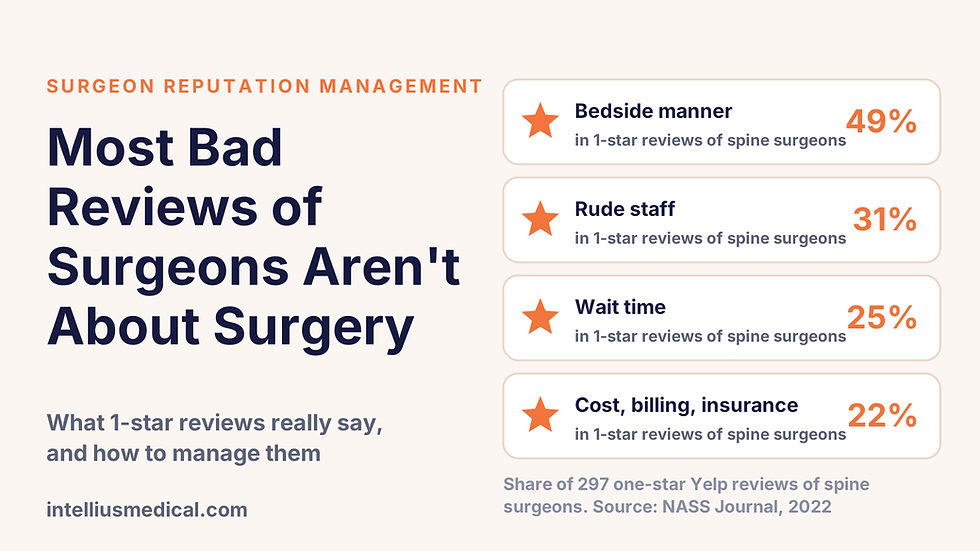
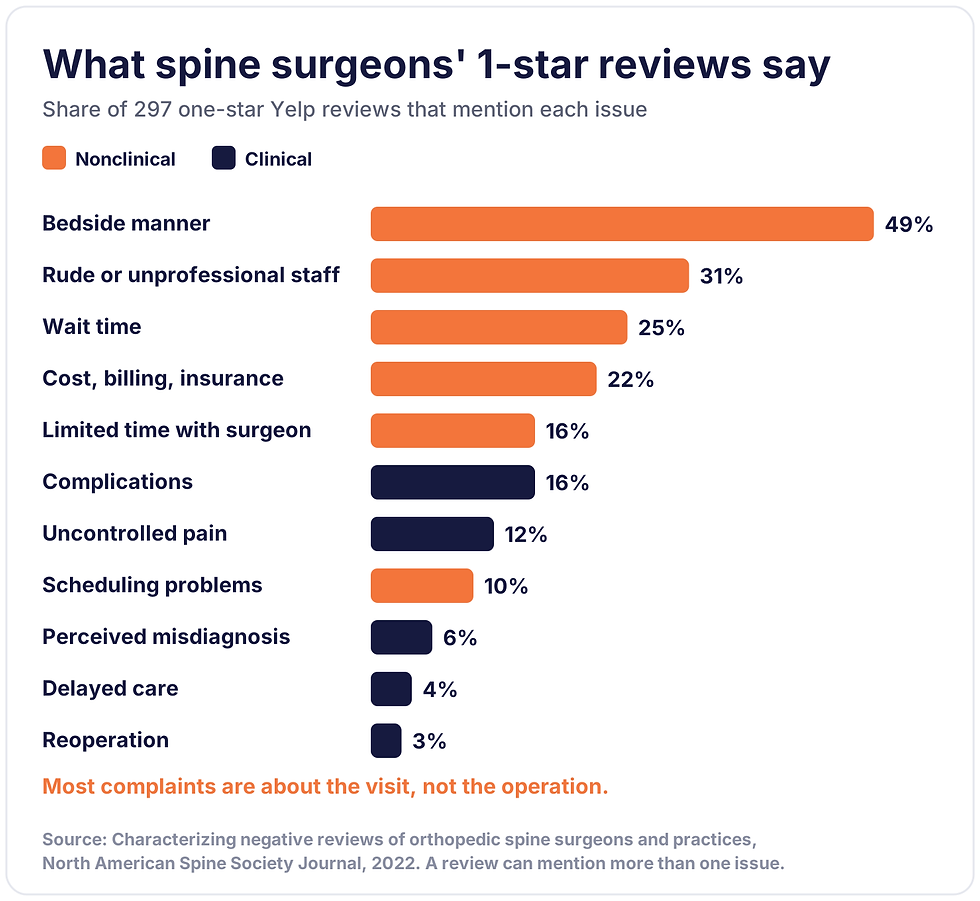
Most bad reviews of surgeons aren’t about the operation. In a study of 297 one-star Yelp reviews of spine surgeons, 76.4% came from people who never had surgery with that surgeon. The top complaints were bedside manner, rude staff and wait times.
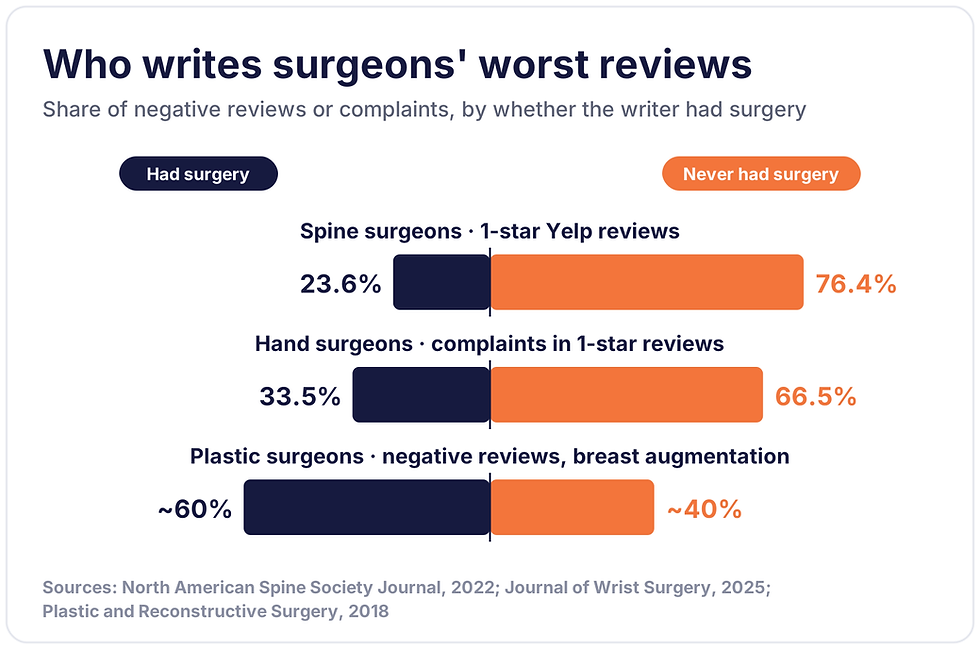
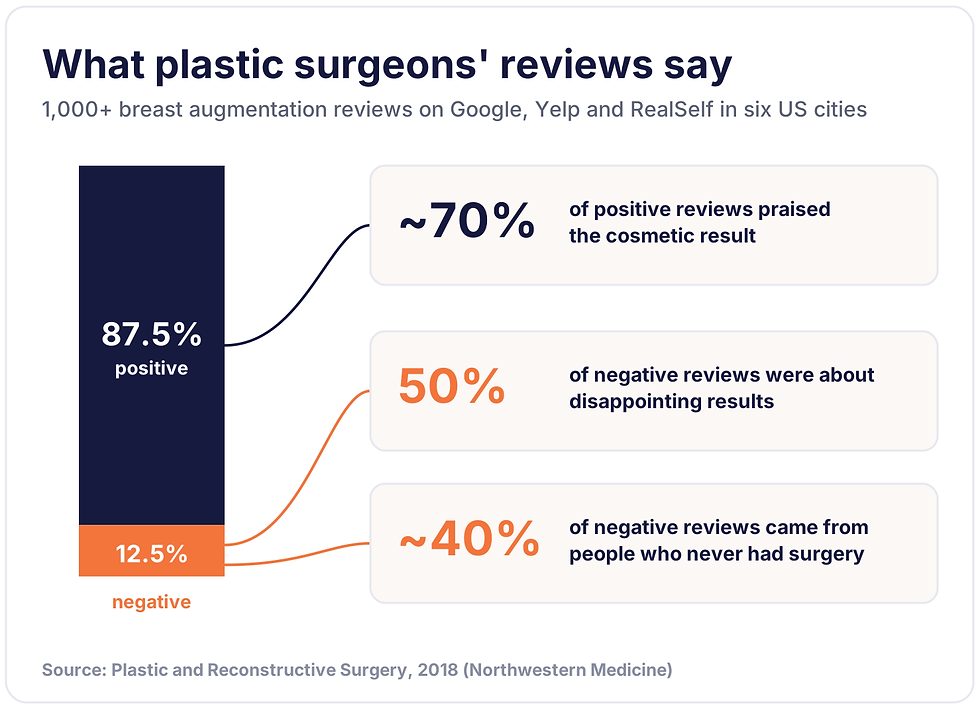
Hand and plastic surgeons see the same pattern. Two-thirds of complaints in one-star reviews of hand surgeons came from nonoperative patients, and close to 40% of negative breast augmentation reviews were written by people who never had surgery.
1-star complaints about surgeons, and the fix | |||
Complaint | Share (spine) | Who fixes it | Fix |
Bedside manner | 49% | Surgeon | Sit down, explain the plan, leave time for questions |
Rude staff | 31% | Practice manager | Train the front desk and review phone calls |
Wait time | 25% | Front desk | Text patients when the clinic runs late |
Cost, billing, insurance | 22% | Billing team | Give a written estimate before surgery |
Limited time with surgeon | 16% | Surgeon | Book longer new-patient consults |
Complications | 16% | Surgeon | Set recovery expectations in writing |
How Surgeons Should Handle Negative Reviews
You must timely attend to negative reviews before they get to the full glare of potential patients. Below are the ways to handle negative reviews as part of surgeon reputation management:
Reply Quickly With a Personal Response
As a surgeon, when you see a negative review, it is crucial that you respond quickly with a personalized response.
The patient who wrote the negative review on your review page is probably not satisfied for one reason or another, so you would want to address the patient’s concern as soon as possible.
When responding to a patient’s negative feedback, you need to be professional and ensure that you’re proffering a solution to the specific issue raised by the patient. Do not ignore negative reviews, as they can greatly harm a surgeon’s reputation.
Ignoring patients’ negative reviews can push potential patients away from your practice and reduce patient retention rates.
Patients expect prompt response from you when they give feedback, particularly when they’re not satisfied with a particular service or treatment. You should be careful when responding to negative reviews.
When responding to a negative review, acknowledge the patient’s feedback and apologize for whatever issue or dissatisfaction the patient is discussing. Then, offer to discuss the issue offline. Never confirm the person was your patient or mention their care, because HIPAA applies to review replies too.
Let your patients know that you appreciate them for seeking your services and that you will continue improving your service delivery to ensure they’re satisfied.
How to reply to a surgeon's negative review | ||
Review says | Reply should | Avoid |
The surgeon rushed me | Thank them and invite them to call the office manager | Defending the consult in detail |
The staff were rude | Apologize for the experience and say you'll look into it | Naming staff or the reviewer |
My result is uneven | Offer a private conversation with the surgeon | Mentioning surgery, dates or photos |
I waited two hours | Acknowledge the wait and say what's changing | Blaming the schedule |
Looks fake | Keep it short and neutral, then report it to Google | Arguing with the reviewer |
Ask the Patient for a Second Chance
After adequately responding to the negative feedback, you must take active steps to improve patient’s experience with your practice.
Ask your patients how you can improve their experience with your practice in the future. This can help improve your patients’ retention rate.
Negative reviews from your patients may contain valuable information that can help improve your overall service delivery. When patients give feedback on areas that need improvements, incorporate the feedback into your service delivery to improve your service delivery.
Don’t forget to encourage your patients to keep trusting your practice while promising them improved service delivery.
Report Fake or Policy-Breaking Reviews to Google
While every surgeon wants positive reviews, you should also understand that negative reviews can also help improve your service delivery. However, if you feel you’ve some undeserved negative reviews, fake, or misleading reviews, you can take active steps to remove them from your review page.
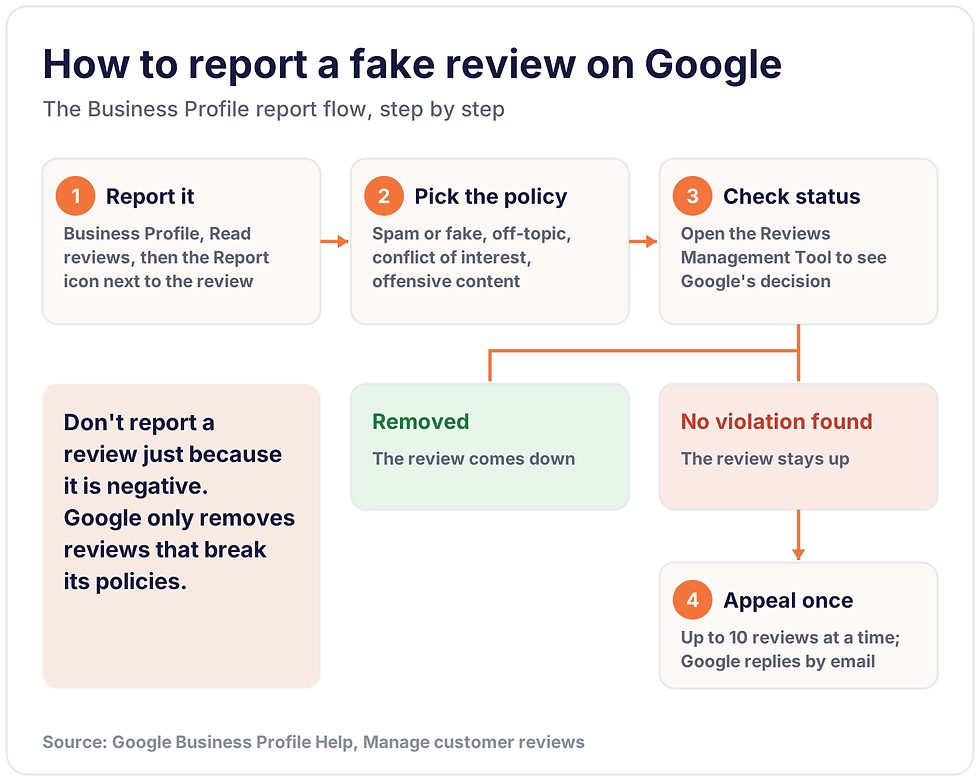
Google only removes reviews that break its policies, such as spam, fake reviews or conflicts of interest. To report one:
Open your Google Business Profile and select Read reviews.
Find the review and select the Report icon next to it.
Choose the policy it breaks, such as spam or conflict of interest, and send the report.
Track the decision in Google’s Reviews Management Tool.
If Google finds no violation, you can appeal once, up to 10 reviews at a time.
A faster way to remove a negative review from your review page is to ask the person who wrote it to delete it. You should only ask a patient to delete a negative review after adequately addressing the review.
You can contact the person who wrote the review privately and politely ask to have the review removed. First, appreciate the person for their feedback and request if he or she will consider removing the review.
Avoid making any demands and be patient with such people. However, the best way to effectively delete a bad review is to drown it out in a sea of good reviews.
5 Review Sites Where Patients Rate Surgeons
Where patients review surgeons | ||
Site | What patients see | Best for |
Google Business Profile | Star rating in Maps and search | Every surgeon |
Healthgrades | Ratings plus training and insurance details | Spine, orthopedic and hand surgeons |
RealSelf | Reviews and photos by procedure | Plastic and cosmetic surgeons |
Yelp | Long, detailed reviews | Practices in big cities |
Recommendations on your page | Practices with an active page | |
Google Business Profile
Google Business Profile is the most important review platform for surgeon reputation management, because its star rating shows up in Google Maps and search results.
Google Business Profile is a great platform for increasing your surgical practice’s awareness online. It displays your practice business page on Google Maps, which increases your digital presence and allows you to reach a wider audience.
Additionally, it gives a direct contact feature which connects you to patients looking for a surgeon. It also has a review segment where patients can write and leave reviews after their experiences with your surgical practice.
Yelp
This is a crowd-sourced local business review and social networking site. It is one of the most popular and powerful online ratings sites.
Yelp focuses on long-form reviews rather than short one-liners, providing the kind of in-depth, thorough reviews that potential patients want to read so that they can have in-depth understanding of your surgical practice.
Healthgrades
This is also a review platform a surgeon can use to receive patients’ reviews. The platform allows patients to leave reviews of their doctors and surgeons, including surgeons.
It offers solid information for patients to assess the practice they want to visit and lets surgeons know what their patients think about their practice.
RealSelf (for Plastic Surgeons)
RealSelf is a review site built for cosmetic treatments. Patients post reviews and before-and-after photos by procedure, and plastic surgeons can answer patient questions on their profiles.
If you’re a plastic surgeon, watch RealSelf as closely as Google. One plastic surgery practice we work with hosts its RealSelf Q&A and reviews on its own website, so Google can crawl that proof.
Facebook Recommendations
Facebook is another powerful review platform that a surgeon can use. The social media platform is also one of the sites patients check before booking a consult.
Instead of a star rating, Facebook asks people whether they recommend your practice and shows those recommendations on your page.
Reputation Monitoring Tools for Surgical Practices
Reputation monitoring tools for surgeons | |||
Tool | What it tracks | Price | Best for |
Google Alerts | New web pages that mention the surgeon | Free | Every surgeon |
BuzzSumo | Articles and social engagement | Paid | Surgeons doing PR or media |
Reputology | Reviews from many sites in one inbox | Paid | Multi-location surgical groups |
Google Alerts
The internet is ever-evolving, and platforms like Google Alerts allow you to stay up to date with managing your reputation online. Somebody might post something that references you as a surgeon on the internet.
Set up a Google Alert for the surgeon’s name and for your practice name. Google will email you when it picks up a new mention, so you can act on it, whether complimentary or not.
BuzzSumo
This content marketing tool has a great reputation management feature. It allows you to comb the web for any content that includes your search term. Its key distinctive feature is including the amount of engagement associated with each search result.
Using search filters like date, country, content type and all, you can know everything that patients are writing about your practice online.
BuzzSumo provides engagement figures for Facebook, X, Pinterest, and Reddit. It provides the total number of links each search result has received. You can create alerts in BuzzSumo to track brand mentions, competitor mentions, keyword mentions, and backlinks.
Reputology
As the name suggests, Reputology helps brands protect their reputation. This tool specializes in review tracking to easily find and monitor brand reviews online. If Yelp, Facebook reviews and similar review sites have a major impact on your surgical practice, this is the tool for you.
It streamlines your reputation management process by delivering all your reviews in one place and even lets you respond to them from within the platform.
Surgeon Reputation Management Strategies
Below are effective surgeon reputation management strategies that you can use to manage your practice reputation.
Audit What Patients Say About the Surgeon Today
An essential surgeon reputation management strategy is to track where the surgeon’s reputation stands today. It would help to analyze your current standing to determine the future of your practice.
Start by monitoring your online reputation on social media and review sites. Also, monitor forums, blogs, and news websites where patients discuss surgeons.
Know what patients say about the surgeon’s reputation and the practice, so you know which areas to improve.
Give Every Team Member a Reputation Job
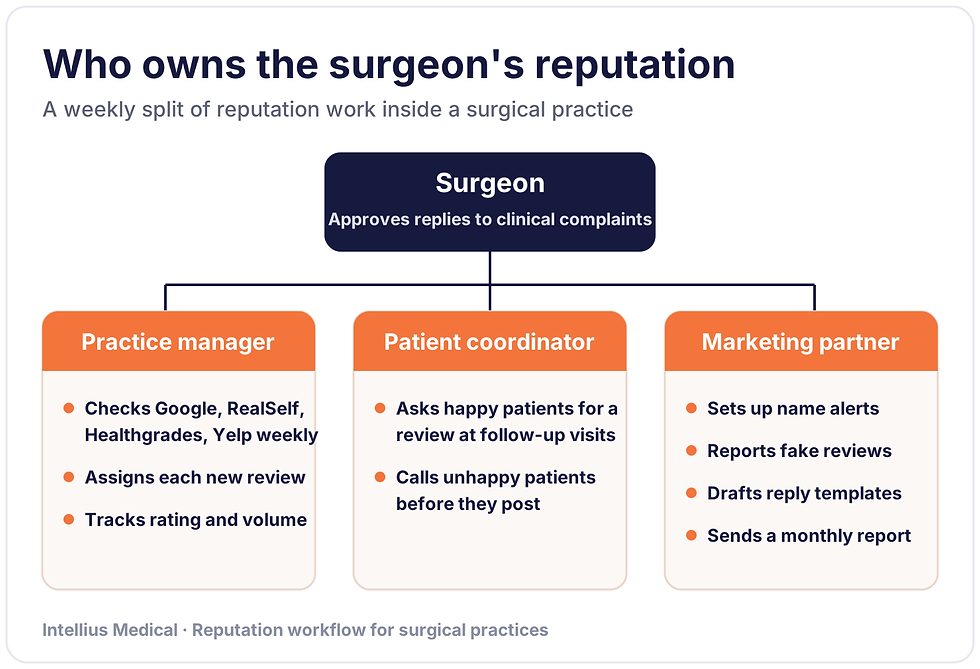
The next strategy is to create an actionable plan to strengthen the surgeon’s reputation. The responsibilities of every person involved in the reputation management process should be distributed in your action plan.
Your action plan can include the person who will be in charge of tracking the feedback and reviews, the person who will be in charge of responding to new reviews, and so on.
Assign specific tasks to each team member so everything is organized and everyone knows their role in surgeon reputation management.
Monitor Reviews Every Week
Surgeon reputation management needs a system to track your reviews, because you can’t always be available to manage them yourself. You can use review websites like Google Business Profile and Yelp to control your reviews.
You can also use reputation management software like Reputology and Google Alerts to keep track of all your reviews and practice mentions online.
Monitoring and controlling your reviews is crucial as it helps to address your patients' concerns before any harm is done to the surgeon’s reputation.
A weekly surgeon reputation management routine | ||
When | Task | Owner |
Monday | Check new reviews on Google, Healthgrades, RealSelf and Yelp | Practice manager |
Within a week | Reply to every new review | Practice manager; surgeon for clinical ones |
Every follow-up visit | Ask happy patients for a review | Patient coordinator |
Weekly | Report fake or policy-breaking reviews | Marketing partner |
Monthly | Compare rating and review count with nearby surgeons | Marketing partner |
Protect the Surgeon’s Name, One Review at a Time
The internet is very large and anyone can say anything online. Many patients read reviews before they choose a surgeon.
This is why reputation management matters so much for surgeons. Most 1-star reviews are about the visit, not the operation, so the fixes are in your hands: longer consults, a kinder front desk and a weekly review routine.
Intellius Medical helps surgeons and plastic surgeons build a surgeon reputation management routine, from Google Business Profile reviews to local SEO for surgeons.