56,589 Google Rankings Across 100 Plastic Surgery Practices, 15 in Texas

Updated: 5 days ago
Here is an uncomfortable number to start with.
52,892 pages crawled across 85 published sitemaps
442,434 backlinks from 78,336 linking websites — of which 51,697 pass no authority at all
56,589 Google rankings, including 19,970 sitting in the top three
400,524 monthly visits, worth $6.3 million a year in traffic nobody paid for
41% of that traffic going to just ten websites
92 of 98 homepages with no price anywhere on them
0 comparison tables found. In 98 websites. Not one.

The 20 Markets We Looked At, Including Austin, Dallas and Houston
Market | Plastic Surgery Practices | Typical monthly visits | Plastic surgeon keywords ranked | Traffic -Best practice in the market |
Beverly Hills / LA | 5 | 16,413 | 1,362 | 18,747 |
New York | 5 | 4,291 | 834 | 10,094 |
Atlanta | 5 | 3,790 | 446 | 19,146 |
Orange County | 5 | 3,662 | 686 | 5,255 |
Denver | 5 | 3,487 | 259 | 5,563 |
Charlotte | 5 | 3,094 | 295 | 7,402 |
Austin | 5 | 3,045 | 654 | 14,077 |
Boston | 5 | 2,966 | 531 | 6,878 |
Philadelphia | 5 | 2,938 | 244 | 5,283 |
Las Vegas | 5 | 2,800 | 590 | 7,681 |
Miami | 5 | 2,670 | 494 | 6,583 |
Chicago | 5 | 2,479 | 350 | 7,890 |
Washington DC | 5 | 1,907 | 413 | 6,015 |
San Diego | 5 | 1,697 | 432 | 14,951 |
San Francisco | 5 | 1,339 | 138 | 11,821 |
Dallas | 5 | 1,182 | 373 | 11,631 |
Houston | 5 | 1,002 | 201 | 29,579 |
Nashville | 5 | 966 | 135 | 2,975 |
Scottsdale | 5 | 664 | 118 | 4,880 |
Seattle | 5 | 478 | 90 | 6,334 |
All 20 markets | 100 | 2,658 | 412 | 29,579 |

These are two real plastic surgeon websites from our study.
Nazarian Plastic Surgery gets 16,413 visits a month and Carolyn Chang gets 807.
Just looking at the websites, you would have understood why.
In this plastic surgery website data study we used multiple seo and organic softwares, even built our own bot in python to analyse the search engine profile of TOP 100 plastic surgeon websites.
Here Is a Summary of Our Key Findings
The busiest quarter of these plastic surgeons get 18x more monthly visitors than the quietest quarter
Winning Plastic surgeons do not rank better. They rank for more. The busiest sites hold 35.7% of their search terms in the top 3. The quietest hold 29.8%.
Top Ten of the Top 100 plastic surgeons capture 41% of all the search traffic.
Your city sets your benchmark. The Top Beverly Hills Plastic surgeon gets 16,413 visits a month. The Top Seattle surgeon website gets 1000-2000. That is a 16x difference between two groups of excellent surgeons.
Total backlink counts barely separate winners from losers — 906 linking sites at the top versus 557 at the bottom, across an 18x traffic gap. So backlinks don't matter much.
Publishing more pages does not mean more traffic. Plastic surgeons with 500–1,000 pages get less traffic than surgeons with 200–500 strong pages.
Practices that market 28 or more procedures get 6x the traffic of practices marketing fewer than 12.
100% of the plastic surgeon websites we crawled contain no comparison table. Not one, out of 98.
94% show no price. 96% have no FAQ markup. 98% have no named author or medical reviewer.
Talking about money is the strongest content signal in the study. Practices whose homepage discusses cost get 3.7x the traffic of practices that avoid it.
Adding question-style headings and FAQ markup on their own did nothing. Neither did LocalBusiness schema, breadcrumb schema, Person schema or citing medical journals.
"Board certified" appears on 82% of these homepages. It is the cost of entry, not a differentiator.
Running Google Ads gives you no SEO advantage — and 70 of the 100 most plastic surgeons in America are not bidding on their own market at all.
Google now answers "what does a facelift cost in Dallas" itself, with a full price breakdown, citing sources that are not in this study.
When AI names the best surgeons in a city, it favours editorially-mentioned practices, not the busiest surgeons.
Let's get into it.
How We Built This Study
Step 1. We chose the markets. Twenty of the largest aesthetic markets in the United States, three of them in Texas (Austin, Dallas and Houston)
Step 2. We chose the practices — before looking at any numbers. Five SEO prominent, organically ranking, independently owned plastic surgeons in each market.
Step 3. We pulled their search profile. For every plastic surgeon site, we collected how many keywords, ranking positions, number of visitors, backlinks, page content study and more.
Step 4. We crawled all top 100 websites ourselves. We opened every homepage and counted, in plain terms:
What we counted | Why it matters to you |
Pages on the whole website | How much of the market you can possibly cover |
Procedures linked from the homepage | How much of what you actually do is marketed |
Links from your homepage to your own pages | Which of your pages Google treats as important |
Words on the homepage | Whether there is anything for Google to read |
Images and galleries | Whether there is anything for a patient to see |
Comparison tables | The format AI assistants quote most often |
FAQ sections and question headings | Whether you answer what patients actually ask |
Any price shown | The number one question a prospective patient has |
Financing mentions | Whether you address affordability at all |
"Board certified" and credentials language | How much of the page is credential claims |
Named author or medical reviewer | Whether a human stands behind the content |
Links to outside sources | Whether the content is referenced |
Schema markup, all types | The technical labels agencies charge for |
Step 5. We photographed everything. Every plastic surgery website, search result and AI answer in this study was screenshotted live in August 2026.
Step 6. We checked our coverage. 98 of the 100 homepages loaded. We found xml sitemaps for 85.
Every number below comes from that dataset.
Part 1: Where You Actually Stand
Here is the whole study on one page. We split the 100 plastic surgeon websites into four groups of 25, from the busiest to the quietest.
Busiest 25 | Next 25 | Next 25 | Quietest 25 | |
Monthly visits from Google | 7,681 | 3,487 | 1,519 | 418 |
Monthly value of that traffic | $11,615 | $4,960 | $2,070 | $651 |
Search terms they rank for | 1,254 | 590 | 297 | 83 |
Terms ranked in the top 3 | 397 | 187 | 79 | 24 |
Share of their terms in the top 3 | 35.7% | 34.5% | 26.6% | 29.8% |
Pages published | 1,017 | 414 | 624 | 207 |
Terms earned per page | 1.44 | 1.06 | 0.44 | 0.25 |
Websites linking to them | 906 | 714 | 641 | 557 |
Links that actually pass authority | 315 | 197 | 180 | 84 |
Share of links that pass nothing | 67% | 74% | 74% | 85% |
Domain Rating | 31 | 23 | 21 | 13 |
Most Leading Plastic Surgeons Get Less Search Traffic Than They Assume

The typical practice in this study gets 2,658 visits a month from Google.
KEY TAKEAWAY: If you are getting 1,500 visits a month and feeling behind, you are roughly mid-pack among the most prominent plastic surgeons in America.
The Busiest Quarter Get 18 Times More Organic Visitors Every Month than the Quietest

Split the 100 into four groups by traffic and the spread is enormous:
7,681 visits a month at the top
418 visits a month at the bottom.
Same specialty. Same procedures. Same kind of patient. Same major metros.
KEY TAKEAWAY: Being a great surgeon in a great market does not put you in the top group. Something the top group does with their website does.
Organic Traffic Gap Is Worth About $11,000 a Month in Advertising You Would Not Have to Buy from Ads

Here is a simple way to read this chart.
Every visitor who finds you through Google is a visitor you did not pay for. If you wanted that same person to arrive tomorrow instead, you would buy them as a Google Ads click. So we priced each group's traffic at what those clicks cost.
Monthly value of free traffic | A year | |
Busiest 25 practices | $11,615 | $139,380 |
Next 25 | $4,960 | $59,520 |
Next 25 | $2,070 | $24,840 |
Quietest 25 practices | $651 | $7,812 |
This study prices the average visitor at about $1.49[low end]. Usually google ads clicks will cost 3-4x than this.
KEY TAKEAWAY: Plastic surgeons at the top are not "doing well at SEO." They are running a six-figure annual advertising program for free, while their competitor across town pays 10K a month for the same patients..
Ten Plastic Surgeons Capture 41% of All the US Traffic, Three of Them in Texas

Practice | Market | Monthly visits | Share of study traffic | Terms ranked | Pages |
Memorial Plastic Surgery | Houston | 29,579 | 7.4% | 3,136 | 468 |
Georgia Plastic | Atlanta | 19,146 | 4.8% | 3,520 | — |
Rady Rahban | Beverly Hills | 18,747 | 4.7% | 1,362 | 1,813 |
Daniel Barrett | Beverly Hills | 16,523 | 4.1% | 1,775 | 1,000 |
Nazarian Plastic Surgery | Beverly Hills | 16,413 | 4.1% | 1,929 | 1,995 |
Chasan Plastic Surgery | San Diego | 14,951 | 3.7% | 1,514 | 1,269 |
Austin Plastic Surgeon | Austin | 14,077 | 3.5% | 1,639 | 1,166 |
Sieber Plastic Surgery | San Francisco | 11,821 | 3.0% | 1,449 | — |
Rod Rohrich | Dallas | 11,631 | 2.9% | 1,262 | — |
Neinstein Plastic Surgery | New York | 10,094 | 2.5% | 1,678 | 521 |
These ten combined | 162,982 | 41% | |||
The other 90 practices | 237,542 | 59% |
Look at the "terms ranked" column. Every single one of the surgeons ranks for more than 1,200 search terms. The average ranks for 412.
Three of the ten are in Texas: Memorial Plastic Surgery in Houston (#1 of all 100), Austin Plastic Surgeon and Rod Rohrich in Dallas. Together they draw 55,287 visits a month, 13.8% of all traffic in the study.
KEY TAKEAWAY: In your city, one or two plastic surgeons are absorbing most of the search traffic. It is not because they rank higher than you. It is because they show up for three times as many things.
Nearly a Third of Prominent Practices Get Under 1,000 Visits a Month

Monthly visits | Practices |
Under 500 | 18 |
500 – 1,000 | 11 |
1,000 – 5,000 | 47 |
Over 5,000 | 24 |
KEY TAKEAWAY: If a marketing company tells you "everyone in your space is at 5,000 visits," they are wrong. Most are not. But most are also leaving the door wide open.
Your City Decides Your Benchmark, Not Your Speciality

The typical Beverly Hills Plastic surgeon: 16,413 visits a month from Google.
The typical Seattle practice: 478. That is 34x, between two sets of accomplished surgeons doing the same operations.
What a Typical Plastic Surgeon in Each City Earns in Free Traffic

Beverly Hills sits around $13,598 a month in free advertising. Seattle sits around $742. Scottsdale, Nashville and Houston all come in under $2,100 despite being genuinely competitive surgical markets. In Texas, Austin sits around $4,402 and Dallas around $2,252.
In Every Market, One Plastic Surgeon Is Stealing almost all the traffic

Market | Best practice | Typical practice | Gap |
Houston | 29,579 | 1,002 | 30x |
Seattle | 6,334 | 478 | 13x |
Dallas | 11,631 | 1,182 | 10x |
San Diego | 14,951 | 1,697 | 9x |
San Francisco | 11,821 | 1,339 | 9x |
Scottsdale | 4,880 | 664 | 7x |
Atlanta | 19,146 | 3,790 | 5x |
KEY TAKEAWAY: There is one surgeon in your city eating most of the SEO traffic. That surgeon's site is your real competitor, not the plastic surgeon whose work you respect most.
How Many Links You Actually Need Depends on Your City and It Is Fewer Than You Think

Every plastic surgeon site has two link numbers. The total number of websites linking to them, and the much smaller number that actually pass authority. Only the second one does anything, and it is the second one below.
Market | Real links | Market | Real links |
Beverly Hills / LA | 329 | Boston | 191 |
Austin | 261 | Miami | 190 |
Atlanta | 217 | Philadelphia | 190 |
Charlotte | 209 | San Diego | 175 |
New York | 202 | Washington DC | 161 |
Dallas | 184 | Denver | 153 |
Las Vegas | 179 | Orange County | 135 |
San Francisco | 176 | Chicago | 120 |
Nashville | 100 | Seattle | 87 |
Houston | 94 | Scottsdale | 61 |
KEY TAKEAWAY: "You need 500 backlinks" is not a strategy, it is a quote. In half of these markets, the surgeon sites has fewer than 180 real links. In Scottsdale it is 61.
Website Authority[Ahrefs] Varies Far Less Between Cities Than Traffic Does

Domain Rating — Ahrefs score — ranges from about 6 to 32 across markets. Traffic ranges 34x.
The Texas Cut: Austin, Dallas and Houston
15 of the 100 practices are in Texas, five each in Austin, Dallas and Houston. Houston has the busiest website of all 100, yet its typical practice has a Domain Rating of 9 and 94 real links.
Plastic surgery website data for Texas: 15 practices | ||||
Market | Typical visits/mo | Busiest practice (visits/mo) | Real links (typical) | Domain Rating (typical) |
Houston | 1,002 | Memorial Plastic Surgery (29,579) | 94 | 9 |
Austin | 3,045 | Austin Plastic Surgeon (14,077) | 261 | 30 |
Dallas | 1,182 | Rod Rohrich (11,631) | 184 | 16 |
All 100 practices | 2,658 | Memorial Plastic Surgery (29,579) | about 169 | 23 |
Source: Ahrefs and our own crawl of all 100 websites, August 2026.

Key takeaway: In Houston the busiest practice gets 30 times the traffic of the typical one. In Texas, the website to beat is one big site per city, not five.
Proof from Dallas: a Dallas plastic surgery practice we work with grew to 537 indexed URLs and 350K+ words of original content. It now takes about 150 patient calls a month from organic search and runs at $500K+ a month in practice revenue. See the Dallas plastic surgery SEO case study.
Part 2: You Do Not Have a Ranking Problem
This is the section that changes how most plastic surgeons should think about their website. Let me explain it as simply as I can.
Think of Every Search Term as a Separate Race

When a patient types "rhinoplasty recovery time" into Google, that is one race, with ten runners on page one.
"Mommy makeover cost Dallas" is a different race. "Am I a candidate for a breast lift" is another. Thousands of these races run in your city every month.
Two things decide how many patients find you:
1. How many races you enter. You can only enter a race if you have a page about that topic.
2. How often you finish in the top three. Call that your hit rate.
Every agency sells you the second one. The data says the first one is what separates the winners.
Busiest Plastic Surgeons Hold 16 Times More Top-3 Organic SEO Positions

Same hit rate. Wildly different number of races entered — so wildly different number of wins.
Group | Races entered [SEO keywords] | Top-3 finishes | Hit rate |
Busiest 25 | 1,254 | 397 | 35.7% |
Next 25 | 590 | 187 | 34.5% |
Next 25 | 297 | 79 | 26.6% |
Quietest 25 | 83 | 24 | 29.8% |
A surgeon with 24 top-3 seo rankings and a practice with 397 top-3 seo rankings are equally good at ranking. One of them just showed up 15 times more often and is making 15x money.
Top plastic surgeons rank for 15 Times More Search Terms

Search terms each group ranks for: 1,254 → 590 → 297 → 83.
That is the whole study in four numbers.
TOP Surgeons Also Own 14 Times More Organic SEO Positions 4 Through 10

Every surgeon obsesses over the top three on Google page 1. But ranking from 4th to 10th still puts you on page one and gets you more patients.
Top surgeons don't always rank in the top 1-2 positions, they also rank in 620 of top 4-10th SERP.
The quietest surgeon holds 44 only.
KEY TAKEAWAY: A practice sitting 6th for 400 terms beats a practice sitting 1st for 30 terms. Every time. Stop paying for rank reports that only show the top 3.
The Winners Have the Same Shape of Rankings — Just Much Bigger

Stack each surgeon group's rankings by SEO position and the proportions look nearly identical. About a third in the top 3, a big block in 4–10, a tail beyond.
Create more procedure pages, Get More Patients. Here Is the Price List.

Here are the top plastic surgeons, purely by how many search terms they rank for, and look at what each band gets:
Search terms the practice ranks for | Practices | Monthly visits | Monthly value |
Under 100 | 15 | 418 | $632 |
100 – 300 | 28 | 990 | $1,681 |
300 – 700 | 29 | 2,966 | $4,170 |
700 – 1,500 | 21 | 6,015 | $8,112 |
Over 1,500 | 7 | 16,413 | $18,506 |

We Could Not Find a Single Exception in 100 Practices

This chart is simpler than it looks.
Every orange dot is one plastic surgeon.
The further right a dot sits, the more search terms that practice ranks for. The higher it sits, the more visitors it gets.
The dots climb steadily from bottom-left to top-right. That means the two things move together, practice after practice.
Now look at the shaded corner at the bottom right. It is empty. Not one practice out of 100 ranks for a large number of terms and gets little traffic. Build the coverage, and the traffic follows. There were no exceptions.
KEY TAKEAWAY: This is the most reliable relationship in the entire study. Nothing else was this consistent.
Half of These Leading Practices Rank For Fewer Than 412 Terms

The typical practice ranks for 412 search terms. The top performer ranks for 3,520.
KEY TAKEAWAY: The gap between you and the leader in your market is measured in hundreds of missing pages, not in a few missing links.
Part 3: Coverage Is the Product
If entering more races wins, the next question is how you enter more races. You publish more pages, each aimed at something specific. Here the data gets very concrete.
To Lead Your Market, Plan for Roughly 1,000 Pages

Where you want to be | Pages on the website |
Top 10 practices in America | 1,166 |
Busiest 25 practices | 1,017 |
Typical practice in this study | 400 |
Quietest 25 practices | 207 |
That is the real number. Not "a blog post a week." Roughly a thousand pages, built over years, each aimed at a specific thing a patient searches for.
If that sounds impossible, remember what a page is: one procedure. One variation of that procedure. One recovery question. One cost question. One before-and-after case. One location. A single procedure like rhinoplasty can honestly support forty pages.
KEY TAKEAWAY: Set the target at 1,000 pages and work backwards. At 8 pages a month you get there in ten years. At 25 a month you get there in three. That number, not your ranking position, is the real decision in front of you.
What a Thousand Pages Actually Looks Like

Both of these are prominent, board-certified practices. Shown at the same scale, one homepage is fourteen times taller than the other.
KEY TAKEAWAY: Coverage is not an abstraction. It is visible from across the room.
But Page Count Alone Does Not Work
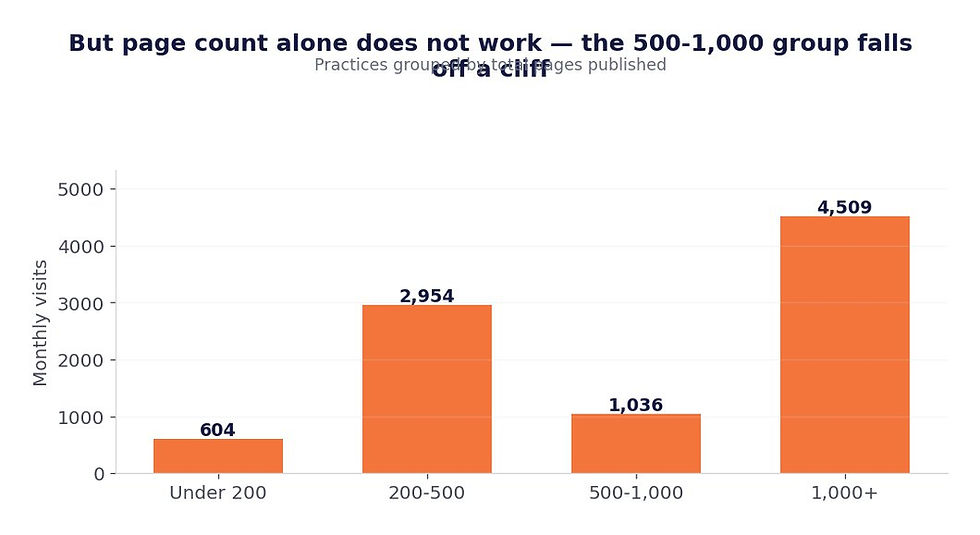
Here is where most content programs in this industry go wrong.
Pages published | Practices | Monthly visits | Terms ranked |
Under 200 | 16 | 604 | 110 |
200 – 500 | 28 | 2,954 | 380 |
500 – 1,000 | 21 | 1,036 | 203 |
Over 1,000 | 20 | 4,509 | 727 |
Look at the middle two rows. Practices with 500–1,000 pages get less than half the traffic of practices with 200–500 pages, despite publishing twice as much.
That dip is not a fluke. It is what a blog looks like when nobody chose the topics on purpose.
KEY TAKEAWAY: If your agency's deliverable is "four blog posts a month," this table is your future. Volume without targeting produced worse results than a smaller, more deliberate website.
The One Number That Tells You If Your Content Program Is Working

Take your ranking keyword count. Divide by your page count. That is how much each page you publish actually earns.
Group | Terms earned per page published |
Busiest 25 | 1.44 |
Next 25 | 1.06 |
Next 25 | 0.44 |
Quietest 25 | 0.25 |
The best practices earn nearly one and a half rankings for every page they publish. The worst earn one for every four pages.
KEY TAKEAWAY: This is the single best diagnostic in the study, and you can calculate it yourself in thirty seconds. Above 1.0, your content program works. Below 0.5, you are paying for pages nobody was looking for.
Five Big Websites. Completely Different Results.

Here are the five largest websites in the study, and what all that publishing actually bought:
Practice | Market | Pages | Terms ranked | Terms per page | Monthly visits |
DaVinci Plastic Surgery | Washington DC | 3,001 | 221 | 0.07 | 1,519 |
Richards Cosmetic Surgery | Las Vegas | 2,096 | 653 | 0.31 | 2,647 |
Nazarian Plastic Surgery | Beverly Hills | 1,995 | 1,929 | 0.97 | 16,413 |
Rady Rahban | Beverly Hills | 1,813 | 1,362 | 0.75 | 18,747 |
Rikesh Parikh | Seattle | 1,355 | 815 | 0.60 | 6,334 |
DaVinci published 3,001 pages and ranks for 221 terms. Nazarian published a third fewer pages and ranks for nine times more.
Worse: Plastic Surgery CAL in Orange County published 1,293 pages and ranks for 22 terms, 94 visits a month. That is years of work and budget, for nothing.

Here are the two sitemaps side by side. Almost the same number of pages. One earns 87 times more rankings than the other.
KEY TAKEAWAY: Ask your agency what each page is supposed to rank for before it is written. If they cannot answer that question, you are buying words, not coverage.
Practices Marketing 28+ Procedures Get 6x the Traffic

We counted how many distinct procedures each homepage links to.
Procedures marketed from the homepage | Practices | Monthly visits |
Under 12 | 6 | 564 |
12 – 19 | 19 | 977 |
20 – 27 | 35 | 2,670 |
28 or more | 32 | 3,404 |
KEY TAKEAWAY: This is the highest-return content decision available to you, and it costs nothing but pages. Every procedure you perform and do not have a real page for is demand you handed to someone else.
The Quietest Sites Market Ten Fewer Procedures Than the Busiest

Procedures linked from the homepage: 28 at the top, 18 at the bottom.
KEY TAKEAWAY: Most practices perform far more than they publish. List every procedure you actually do, then count how many have a real page. That gap is your roadmap for the next two years.
Homepages That Link To More of the Site Get 4x the Traffic

Links from the homepage into the site | Practices | Monthly visits |
Under 100 | 18 | 724 |
100 – 159 | 25 | 1,319 |
160 – 219 | 17 | 2,975 |
220 or more | 32 | 3,006 |
Your homepage is the most trusted page you own. What it links to is what Google treats as important.
KEY TAKEAWAY: This is free, it takes an afternoon, and it outperformed most of the link building in this study.
Your Homepage Is a Map. The Quiet Sites Draw a Smaller One.

Links from the homepage: 210 at the top, 122 at the bottom.
KEY TAKEAWAY: Minimalist homepage design is often a search decision disguised as an aesthetic one. If your whole procedure menu is hidden behind a hamburger icon, you have made a choice.
Image-Rich Homepages Outperform Sparse Ones by 6x
Nobody claims images are a ranking factor, and we do not either. We counted them because we suspected image count was standing in for something else — and it turned out to be one of the sharper splits in the study.

Images on the homepage | Monthly visits |
Under 15 | 785 |
15 – 29 | 2,640 |
30 – 59 | 1,802 |
60 or more | 4,829 |
We do not think images cause rankings. We think image count is a sign of something real: galleries, results, staff, facility, procedure thumbnails — a site with something to show.
KEY TAKEAWAY: In aesthetics, a thin website is a credibility problem before it is a search problem.

Homepages Under 900 Words Are the Clearest Self-Inflicted Wound

Words on the homepage | Monthly visits |
Under 900 | 736 |
900 – 1,499 | 2,380 |
1,500 – 2,499 | 2,605 |
2,500 or more | 4,664 |
KEY TAKEAWAY: The jump happens at around 900 words. Get past it. After that the returns are real but much slower — do not let anyone sell you a 4,000-word homepage.
A Longer Page Brings More Visitors, Not Better Ones

Longer pages bring more people. We wanted to know whether they bring better people — visitors closer to booking rather than visitors browsing.
They do not.
Words on the homepage | What each visitor is worth |
Under 900 | $1.96 |
900 – 1,499 | $1.45 |
1,500 – 2,499 | $1.49 |
2,500 or more | $1.38 |
If anything, the shortest homepages brought slightly more serious visitors.
KEY TAKEAWAY: Length gets you found. It does not get you the right patient. Those are two different jobs and they need two different pages — a long page to be discovered, and a focused page to book the consult.
Part 4: The Link Story You Have Been Sold Is Wrong
Every SEO Report Opens With a Link Count. It Is the Least Useful Number on the Page.
Ask any agency in this space how your SEO is going and you will hear a link number. It is the industry's default proof of work, and it is on the cover of almost every monthly report sent to a medical practice.
So we tested it. Here is the total number of websites linking to each of our four groups:

906 → 714 → 641 → 557.
A 1.6x spread across an 18x spread in traffic. If someone handed you only that column, you could not tell the winners from the losers.
KEY TAKEAWAY: The headline number on your report separates almost nothing.
Only About a Quarter of Your Links Do Anything
Every link is one of two kinds. Some pass authority to your site. Some — mostly from directories, review sites and listing networks — carry a tag in the code that tells Google to pass nothing at all. Both kinds appear on your report as backlinks.
Here is what one of those links actually looks like, taken from a live plastic surgery directory:

That listing counts as a backlink on your report. The two words `rel="nofollow"` mean it hands you nothing.
Across all 100 practices, 76.4% of the typical link profile is that kind of link. Filter them out and a real signal appears immediately:
Group | Total links | Links that pass authority | Dead weight |
Busiest 25 | 906 | 315 | 67% |
Next 25 | 714 | 197 | 74% |
Next 25 | 641 | 180 | 74% |
Quietest 25 | 557 | 84 | 85% |

The same practices, the same reports, a 3.8x separation the moment you look at the right column.

KEY TAKEAWAY: Ask for followed referring domains, not total referring domains. Your report says 660. The number that matters is closer to 169. If your agency hesitates at that question, you have your answer.
Practices With the Cleanest Link Profiles Get 15x the Traffic

Share of links that pass nothing | Practices | Monthly visits |
Under 65% | 20 | 6,992 |
65 – 75% | 25 | 2,545 |
75 – 85% | 37 | 2,540 |
Over 85% | 18 | 474 |
This was the strongest negative signal anywhere in the study. Nothing else came close.

Plotted practice by practice, the pattern holds: past the 80% mark, the high-traffic practices vanish from the chart almost entirely.
Directory links are not harmful. The problem is what a profile made mostly of them tells you — that nobody has ever written about this practice anywhere that mattered.
KEY TAKEAWAY: If your dead-weight share is above 85%, you are in the group getting 474 visits a month, and more directory work will not move you out of it.
The First Hundred Real Links Matter More Than the Next Four Hundred

Links that pass authority | Practices | Monthly visits |
Under 100 | 23 | 511 |
100 – 199 | 41 | 2,647 |
200 – 399 | 24 | 3,428 |
400 or more | 12 | 10,426 |
Crossing 100 is worth 5.2x. The step from 100 to 200 is worth 1.3x.
We also counted how many genuinely distinct networks link to each practice — a measure that is much harder to inflate with a directory package, because those listings often share hosting. It separated the field better than the raw count did: 395 → 316 → 295 → 259.
KEY TAKEAWAY: Twenty links from twenty different real websites beat two hundred from one network. And if you are under 100 real links, that is your whole project this year.
Authority Is a Floor to Clear, Not a Ladder to Climb
Domain Rating is the score agencies quote when they justify a retainer. The assumption is that it works like a ladder — every point you gain moves you up. The data says it works like a floor.

Domain Rating | Practices | Monthly visits |
Under 15 | 25 | 516 |
15 – 24 | 27 | 2,970 |
25 – 34 | 39 | 3,045 |
35 or more | 9 | 9,031 |
Going from under 15 into the 15–24 band is worth 5.8x. Going from 15–24 to 25–34 is worth almost nothing — 2,970 to 3,045.

And the bar itself is low. The typical leading plastic surgery practice sits at a Domain Rating of 23 — a level a focused practice can reach inside a year.
KEY TAKEAWAY: This is not a fortress market. It only looks like one because everyone is fighting over the same handful of terms. Clear the floor, then stop paying to climb.
Two Lists That Tell You Which Problem You Actually Have
Put authority and traffic side by side and the practices split into two groups with completely different problems.
Group one: strong results, weak authority. Twelve practices with a Domain Rating of 22 or below pull more than 3,000 visits a month.

Practice | Market | Domain Rating | Real links | Monthly visits |
Dr. Kim Surgery | Chicago | 22 | 70 | 7,890 |
Rikesh Parikh | Seattle | 22 | 87 | 6,334 |
Millard Plastic Surgery | Denver | 16 | 91 | 5,563 |
Amy Alderman | Atlanta | 15 | 124 | 5,445 |
Colorado Plastic Surgery | Denver | 12 | 153 | 4,664 |
What they share is not links. It is large websites, deep procedure coverage and heavy internal linking. Dr. Kim's site earns 113 visits for every website linking to it. The typical practice earns about 16.

Group two: strong authority, weak results. Nine practices with a Domain Rating above 25 get under 1,500 visits a month.

Practice | Market | Domain Rating | Monthly visits |
Faces+ | San Diego | 34 | 1,106 |
Dr. Stile | Las Vegas | 33 | 1,036 |
Washington Women's | Washington DC | 31 | 463 |
Aesthetic Surgery Charlotte | Charlotte | 29 | 806 |
Perimeter Plastic Surgery | Atlanta | 29 | 977 |
These practices already have the links. They never built the pages to spend them on.
KEY TAKEAWAY: Find yourself on one of these two lists before you approve another budget. If your authority is low and your traffic is decent, keep publishing. If your authority is high and your traffic is weak, you do not have a link problem you have a coverage debt, and more link building will not touch it.
Part 5: The AI Gap Nobody in This Specialty Has Filled
This is no longer a prediction. Here is a live Google search for "facelift cost dallas" (Dallas, Texas), captured while writing this study.

Google answers the question itself, before any practice website appears. It gives a full price breakdown by procedure type — mini facelift $4,000 to $11,000, standard SMAS $12,000 to $22,000, deep plane $25,000 to $50,000 and up — and then explains what is included in the price.
Two things about that answer matter to you.
First, it is a comparison table. That is the format these systems reach for, and it is the exact format that zero of the 98 websites we crawled contain.
Second, look at who it cites. A facial plastic surgery institute, a cost guide, individual surgeons' blog posts. Not one of the hundred leading practices in this study.
The same pattern holds in other cities and other procedures:

Those systems quote content that directly answers questions: prices, comparisons, FAQ blocks, cited facts, named experts.
So we measured how much of that exists on the websites of the 100 leading practices in America.
What Almost Every Leading Plastic Surgery Website Is Missing

Out of 98 websites we successfully crawled:
What is missing | Practices missing it | Why an AI assistant needs it |
A comparison table | 100% | The single most quotable format there is |
A named author or medical reviewer | 98% | Establishes who is answering |
FAQ markup | 96% | Labels your answers as answers |
Video markup | 96% | Makes video content quotable |
Any price on the page | 94% | The most-asked patient question |
Any statistic | 89% | Gives an assistant something to cite |
A link to any outside source | 77% | Shows the claim is referenced |
An FAQ section | 77% | Where patient questions get answered |
One question-style heading | 58% | Matches how patients phrase things |
KEY TAKEAWAY: The entire specialty has left the answer layer empty. That is why RealSelf, Healthline and hospital systems get quoted when a patient asks an AI what a facelift costs in your city. It is not that they outranked you. It is that you did not answer.

Your Own Professional Society Publishes the Prices You Won't

The American Society of Plastic Surgeons posts an average national cost for every procedure it lists. So does every aggregator, every general health publisher, and now Google itself.
The people who actually perform the operations are the only ones staying quiet about what they charge.

KEY TAKEAWAY: The question gets answered either way. The only decision you control is whether the answer comes from your website or from someone who has never met you.
When AI Names Surgeons, It Does Not Name the Busiest Ones
This was the most surprising thing we found, and it complicates the story above in a way worth being honest about.
We searched for "best plastic surgeon in seattle" — Seattle being the lowest-traffic market in the entire study, where the typical practice gets 478 visits a month.

Google's AI named five surgeons. Four of the five are practices in this study. And it cited a city magazine's Top Doctors list as its main source, alongside the practices' own websites.
So being named by an AI assistant is not simply a reward for having the biggest website. In this case it tracked something else entirely: independent editorial mentions — a magazine list, a society directory, a "top doctor" feature.
That gives you two separate jobs, and they are not the same job:
To be found in search | To be named by an AI assistant |
Publish more pages, aimed at more terms | Get mentioned by sources the AI already trusts |
Cover every procedure you perform | City magazines, society lists, press, podcasts |
Answer cost, recovery and comparison questions | Consistent naming of you and your practice everywhere |
Measured in visits | Measured in citations |
KEY TAKEAWAY: A practice can be quiet in Google and still be the one an AI recommends — and the reverse is also true. If you only measure traffic, you will not see either happening.
But Adding Question Headings On Its Own Does Nothing

We need to be honest about this, because it cuts against the easy version of the advice above.
Question-style headings on the homepage | Monthly visits |
None | 2,923 |
1 – 3 | 1,907 |
4 or more | 4,296 |
There is no clean line there. Formatting a heading as a question is not a growth lever.
Here is what actually answering them looks like, from one of the few practices in the study that does it:

KEY TAKEAWAY: Cosmetic changes to headings do nothing. Answering questions nobody else answered is a completely different thing.
FAQ Markup By Itself Is Not the Answer Either

The four practices using FAQ markup average 2,024 visits. The 88 without it average 2,542.
KEY TAKEAWAY: Markup describes content. It does not create it. If the answer is not on the page, tagging it changes nothing.
Every Schema Type Your Agency Sells Shows Up Equally on Winners and Losers
Structured data has been sold as a differentiator in medical marketing for years — physician markup, review stars, LocalBusiness listings. It is often the most technical-sounding item on a proposal. We checked whether any of it separated the two halves of our sample.

Schema type | On the busier half | On the quieter half |
Medical / physician markup | 55% | 57% |
Review markup | 47% | 53% |
Person markup | 22% | 33% |
LocalBusiness markup | 12% | 18% |
Breadcrumb markup | 47% | 45% |
Not one of them separated the groups. Two appear more often on the losers.
KEY TAKEAWAY: Schema is hygiene. Have it, do not pay a premium for it, and never accept it as the deliverable.
Citing Medical Journals Is Not What Moves Traffic

Practices that link out to journals, studies or medical societies: 1,319 visits. Practices that do not: 2,800.
KEY TAKEAWAY: Cite sources because it is the right thing to do for a patient reading about surgery. Do not expect Google to pay you for it. Anyone selling "E-E-A-T optimization" as a traffic strategy should be asked for their data.
"Board Certified" Is Table Stakes, Not a Differentiator


82% of these homepages say "board certified." It is the single most common phrase in the specialty.
KEY TAKEAWAY: When four out of five competitors open with the same three words, those three words are no longer positioning. They are wallpaper.
Talking About Money Is the Strongest Content Signal in the Study

Here is the finding we did not expect.
Homepage content | Practices doing it | Their traffic | Everyone else | Difference |
Discusses cost or pricing | 68 | 2,930 | 796 | 3.7x |
Mentions financing | 68 | 2,930 | 887 | 3.3x |
Links a before-and-after gallery | 71 | 2,647 | 1,106 | 2.4x |
We are not claiming that adding the word "cost" to your homepage triples your traffic. Practices that discuss money openly tend to be practices that built out cost pages, financing pages and procedure pages — the whole commercial layer.
But the direction is unambiguous, and it points at exactly the content this specialty refuses to publish.
KEY TAKEAWAY: "How much does it cost" is the highest-intent question a prospective patient asks. 94% of leading practices do not answer it on their own website. That is why third-party sites own the answer and increasingly, why AI assistants quote them instead of you.
What Actually Tracks With Getting Found — and What Doesn't

Signals that separated winners | Signals that separated nobody |
How many terms you rank for | Title tag length |
Rankings held at every position band | Meta description length |
Variety of networks linking to you | Number of H1, H2 or H3 headings |
Terms earned per page published | Paragraph length |
Share of links that pass authority | Question-style headings |
Procedures marketed | Bulleted lists |
Links from your homepage | Page weight |
Images on the homepage | Total amount of schema markup |

KEY TAKEAWAY: Most SEO checklists sold to medical practices are made almost entirely of items from the right-hand column.
Part 6: Traffic Is Not Patients
Everything so far has been about being found. This last part is about the fact that being found and being booked are not the same thing — and the study is unusually clear about the gap between them.
The Busiest Websites Attract the Least Valuable Visitor

Group | What each visitor is worth |
Busiest 25 | $1.18 |
Next 25 | $1.49 |
Next 25 | $1.52 |
Quietest 25 | $1.72 |
The line runs backwards. The busiest sites pull in more browsing traffic — recovery questions, "is this normal," general curiosity. The quieter ones pull a higher share of people actually shopping for a procedure.
Individual practices show it even more sharply:
Practice | Market | Monthly visits | Value per visit |
Hatef Aesthetics | Nashville | 495 | $4.24 |
Aesthetic Surgery Charlotte | Charlotte | 806 | $2.79 |
NY Plastic Surgery | New York | 4,177 | $2.16 |
Shafer Plastic Surgery | New York | 9,031 | $0.43 |
VIP Plastic Surgery | Las Vegas | 7,681 | $0.14 |
VIP has 15 times the traffic of Hatef. Hatef's traffic is worth 30 times more per visitor.

KEY TAKEAWAY: If your traffic is up and your consult requests are flat, this is why. Ask your agency what your traffic is worth, not how much of it there is.
The Busiest Sites Squeeze More Out of Every Ranking They Hold

Visits per ranking term: 8.2 at the top, 5.0 at the bottom.
Same rankings, different yield — because the top group chose terms people actually search for.
KEY TAKEAWAY: Keyword selection is a business decision, not a technical one. It should not be delegated without review.
Running Google Ads Does Not Make You Stronger in Organic Search
There is a persistent belief that paid and organic feed each other — that buying clicks warms up your rankings. We could test it, because 30 of our 100 practices run paid search and 70 do not.

Key takeaway: 70 of the 100 practices do not bid on their own market at all, and the 30 that do are no stronger in organic search.
Want This Data for Your Market?
We'll show you where your website stands against the busiest practice in your city, from Houston, Austin and Dallas to any US market. Email daniel@intelliusmedical.com. For the search side, see our 7.5 million search study and our 25-city plastic surgery marketing statistics. Texas practices can also read our Dallas and Houston healthcare marketing guide and our guide to local SEO for plastic surgeons.


